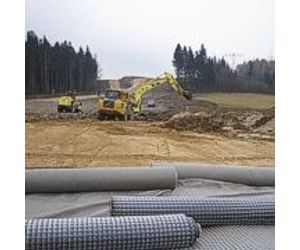
- Home
- Companies
- FRANK GMBH
- Products
- Reinforcement
Reinforcement
Constructions have to rely on the stability of the subsoild - but in most cases it is not as good as it should be. Geosynthetics are a good and easy-to-use alternative. For example sound barriers have to be built very steep. because there is not enough space between the road and the buildings. Often the only possibility is a reinforded wall. The most important value of reinforcement products is the tensile strength at a given elongation (e.g. at rupture or at 5% elongation).
Woven geotextiles are made of different types of yarns (e.g. PP tapes or PET filaments), which are woven at right angles to produce meshes. Like nonwovens, woven geotextiles are divided after weight and puncture resistance in a table of classes from 1 to 5. Their advantage is that you neéd lower weights per square meter (less material means lower price) to reach the same tensile strength and the elongation at rupture is at a range of 10-25% compared to 50-150% for nonwovens. Woven geotextiles made of PP tapes reach a maximum tensile strength of 200 kN/M, where the PET types are just starting.
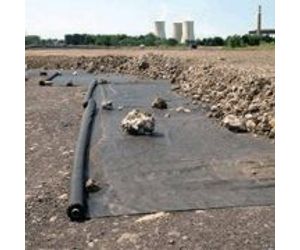
- Separation of the filling material from the subsoil to prevent mixing in road
- Construction, building foundations or embankments
- Inreasing of embankment safety and stability
Geogrids can be made of woven yarns, laser-welded strips or punched out of PEHD or PP membranes. They can be distinguished from woven textiles at first sight, because the minimum mesh size is 10mm, mostly even 30-40mm. All geogrids are stretched in machine direction (monoaxial) or both directions (biaxial) before weaving, so that the polymer chains are reoriented and inital elongation is minimized.
Geogrids are not divded into classes but we can calculate the "right" grid according to your specifications. Sometimes a "design strength" is mentioned in the tender, which means that the max. tensile strength is divided by reduction factors (A1 - A5) and a safety factor beween 1,4 to 1,75. The reduction factors depend on the creep factor of polymer material, the grain size of surrounding material, the connection of adjacent rolls, UV - and chemical resistance and dynamic loads on the whole construction.
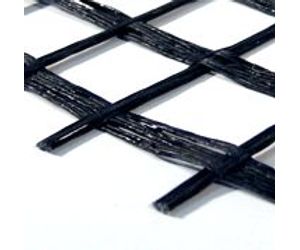
- Reinforcement of steep sided slopes or walls
- Increasing of embankment safety and stability
- Sub base reinfording in railway and highway constructions