


- Home
- Companies
- PicoQuant GmbH
- Products
- MultiHarp - Model 160 - Scalable ...
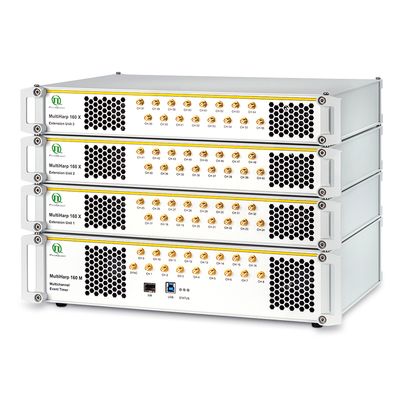
MultiHarp - Model 160 -Scalable Multichannel Event Timer & TCSPC Unit
The MultiHarp 160 is designed as a plug-and-play event timer and Time-Correlated Single Photon Counting (TCSPC) unit which is optimized for applications that require a large number of fast and precise timing channels. The high quality and reliability of the MultiHarp 160 is reflected by our unique 5-year limited warranty.
- Up to 64 independent input channels with 5 ps base resolution
- Scalable via extension units à 16 channels
- Common sync channel (up to 1.2 GHz sync rate)
- Ultrashort dead time (650 ps), no dead time across channels
- Hardware access to data stream via FPGA link
- Ref In / Ref Out / PPS In / White Rabbit interface for multi-device synchronization
- Drivers and demo code for custom programming
- NEW: Multifunctional on-board event filters
Scalable up to 64 input channels
The number of input channels can be scaled to your needs: the main unit (MultiHarp 160 M) provides 16 of them and can be expanded with up to three extension units (MultiHarp 160 X). Each extension unit adds 16 channels to the event timer, thus providing a choice of 16, 32, 48 or 64 synchronized input channels. The MultiHarp 160 M also features a synchronization channel as a timing reference for all 16 to 64 input channels. This synchronization channel supports sync rates of up to 1.2 GHz for periodic sync rates. The data from all input channels are combined into a single data stream that is accessible via the USB 3.0 interface. No additional synchronization tools are required.
All channels of the MultiHarp 160 – including the common sync input – can be used as detector inputs, e.g., for coincidence correlation or coincidence counting. The MultiHarp 160 is also perfectly suited for performing TCSPC with multiple detectors using forward start-stop operation. Here the common sync channel allows for synchronization with the excitation source.
Fast and precise event timing
The MultiHarp 160`s smartly designed time-to-digital converters (5 ps base resolution, <650 ps dead time) allow to fully exploit the count rate limits of time-correlated single photon counting, without having to compromise on the time resolution for many modern single photon detectors. With its ultrashort dead time, multiple photons per excitation cycle can be detected even at the highest repetition rates achievable by modern picosecond pulsed lasers (requires a detector from the PMA Hybrid Series).
Each input channel also features easily accessible parameter settings, which include the trigger parameters as well as programmable timing offsets and hold-off times.
Multifunctional on-board event filters
The MultiHarp 160 has user-defineable on-board event filters to efficiently reduce the file sizes and the amount of data sent via the data interfaces (USB, external FPGA interface).
Data interface for external FPGA boards
For applications with high count rates at multiple input channels, the data read-out speed and/or the data processing speed by the computer is the major bottleneck. This bottleneck can be bypassed by reducing the data size that is sent to the computer. Such a data reduction is for example done in the histogramming mode of the MultiHarp 160, where TCSPC histograms sent to the computer are calculated out of the arrival times of the input signals by the hardware itself.
To enable the greatest possible flexibility, the time tagging data stream of the MultiHarp 160 can be accessed by an external FPGA board via a dedicated FPGA interface. This way, the method of data preprocessing can be tailored to the specific application.
White Rabbit ready event timer
White Rabbit is a fully deterministic, Ethernet-based timing network which provides sub-nanosecond accuracy and precise synchronization of devices over large distances. Thanks to its White Rabbit interface, the MultiHarp 160 is ready to be integrated into set-ups that are using this emerging technology.
Input Channels and Sync: Constant level trigger on all inputs, software adjustable
Number of detector channels
(in addition to Sync input): 16 (Main unit)
32 (Main unit + first extension unit)
48 (Main unit + first and second extension unit)
64 (Main unit + first, second, and third extension unit)
Input voltage operating range (pulse peak into 50 Ohms): -1200 mV to 1200 mV
Input voltage max. range (damage level): ±2500 mV
Trigger edge: falling or rising edge, software adjustable
Input pulse width: > 0.4 ns (rise/fall time max. 20 ns)
Time to Digital Converters
Minimum time bin width: 5 ps
Timing precision*: < 45 ps rms
Timing precision / √2*: < 32 ps rms
Dead time : < 650 ps (can be increased via software up to 160 ns in steps of 1 ns)
Adjustable programmable time offset for each input channel: ±100 ns, resolution 5 ps
Differential non-linearity: < 10 % peak, < 1 % rms (over full measurement range)
Maximum sync rate (periodic pulse train): 1.2 GHz
Histogrammer
Count depth: 32 bit (4 294 967 295 counts)
Full scale time range: 328 ns to 2.74 s (depending on chosen resolution: 5, 10, 20, …, 41 943 040 ps)
Maximum number of time bins: 65 536
Peak count rate per input channel: 1.5 × 10⁹ counts/sec for 2048 events
Total sustained count rate, sum over all input channels: MultiHarp 160 M:
332 × 106 counts/sec (166 × 106 counts/sec per row of 8 input channels)
MultiHarp 160 X1, X2, X3:
332 × 106 counts/sec (166 × 106 counts/sec per row of 8 input channels)
TTTR Engine
T2 mode resolution: 5 ps
T3 mode resolution: 5, 10, 20, …, 41 943 040 ps
FiFo buffer depth (records): 268 435 456 events
Peak count rate per input channel: 1.5 × 10⁹ counts/sec for 2048 events
Total sustained count rate, sum over all input channels**: 80 × 106 counts/sec via USB 3.0 interface
FPGA Data Interface
Throughput T2/T3 Mode: 200 × 106 counts/sec
Throughput T2 Direct Mode: 200 × 106 counts/sec per row of 8 input channels
+ 78 × 106 counts/sec for SYNC input
Latency T2 Mode: 4.5 µs to 5.0 µs
Latency T3 Mode: 4.5 µs to 5.5 µs
Latency T2 Direct Mode: SYNC: 1.7 µs to 1.8 µs
Others: 0.8 µs to 1.2 µs
Trigger Output
Period: programmable, 0.1 µs to 1.678 s (0.596 Hz to 10 MHz)
Pulse width: 10 ns typ.
Baseline level: 0 V typ.
Active level (pulse peak): -0.7 V typ. (50 Ohm)
External Marker Inputs
Number: 4
Input type: LVTTL, < 50 ns rise/fall time, > 50 ns at HIGH or LOW (max 5V for 1 µs), software adjustable hold-off
External Synchronization
Ref IN: 10 MHz
200 … 1500 mV p.p.
50 Ohm; AC coupled
Ref OUT: Default: 10 MHz
White Rabbit mode: 31.25 MHz
1400 mV p.p.
50 Ohm; AC coupled
PPS IN: 1 s, LVTTL
White Rabbit interface: connector for SFP module
Operation
PC interface: USB 3.0
PC requirements: Dual Core CPU or better, min. 2 GHz CPU clock, min. 4 GB memory
Operating system: Windows 10/11
Power consumption: Max. 150 W
Dimensions
MultiHarp 160 M (main unit): incl. feet and handles 285 × 425 × 100 mm
MultiHarp 160 X (extension unit): incl. feet and handles 285 × 425 × 62 mm
The MultiHarp 160 can be used for various applications that call for a time tagger featuring a large number of synchronized inputs without compromises in time resolution and data throughput, such as:
- Coincidence Correlation
- Quantum Communication
- Linear Optical Quantum Computation
- Quantum Entanglement
- Diffuse Optical Tomography
- TD-fNIRS
- LIDAR/Ranging/SLR
- Time-Resolved Fluorescence
- Time response characterization of optoelectronic devices
- Time-Resolved Photoluminescence (TRPL)
- Fluorescence Lifetime Imaging (FLIM)
- Phosphorescence Lifetime Imaging (PLIM)
- Multi-color Lifetime Imaging
- Fluorescence Correlation Spectroscopy (FCS)
- Fluorescence Lifetime Correlation Spectroscopy (FLCS)
- Single Molecule Spectroscopy/Detection
- TRPL Imaging