


- Home
- Companies
- Efficiency Scientific Instrument Co., ...
- Products
- ESI - Model EDX8000T PLUS - SDD XRF ...
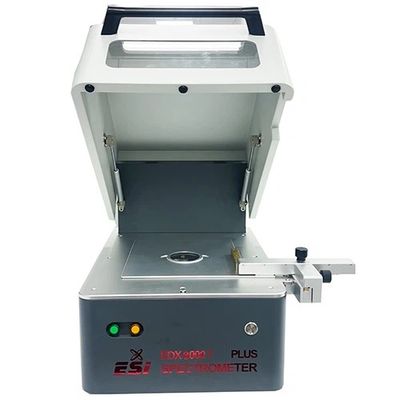
ESI - Model EDX8000T PLUS -SDD XRF Coating Thickness Analyzer
Coatings are typically applied to metals, alloys and plastics to increase corrosion resistance and/or for decorative purposes. In order to ensure correct component properties, coat weight and thickness must be controlled in metal finishing and fabrication, as well as in the automotive and aerospace industries. As one of the most popular non-destructive analysis technology, The EDX-8000T Pro measures coating weight and plating thickness at manufacturing lines. Using a Standard-less Fundamental-Parameter (FP) calibration, the EDX-8000T Pro adapts to numerous testing situations. Use coatings mode to determine coat thickness or weight for up to five(5) layers over a substrate. Users have the ability to measure layers consisting of pure metals, alloys and co compounds, and define substrates consisting of pure metals, alloys, plastics and wood
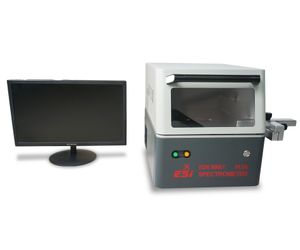
Features
>Positioning of the measuring point on small structures thanks to automatic image recognition
>The software is equipped with distance correction algorithm, which enables accurate testing of irregular samples (such as concave and convex surfaces, threads, curved surfaces, etc.)
>Adoption of closed housing greatly minimizes the risk of x-ray leakage.
>Easy operation enabled with simple interface and help function of the software
>Daily routine measurements can be conducted easily by using registered application-Curve recipe.
- Single Layer Coatings; one metal coating (Zn, Ni, Cr, Cu, etc) over a substrate
- Binary Alloy Coatings
- Multiple Layer (multilayer) Coatings; two or more layers over a substrate (Cr/Ni/Cu)
- common applications in electronics are ENIG and ENEPIG per IPC 4552 and IPC 4556
- Composite coatings over a substrate (AuNi/Cu and ZnNi/Cu)
- composition of the alloy coating can be identified as well
- Thin film measurements (ie wafer fab quality control in semiconductor industry)
- Solution analysis of plating baths
- Measurement methods according to ASTM standards when applicable
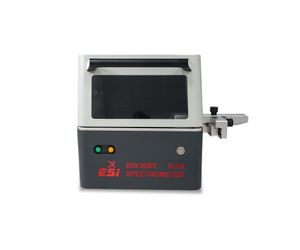
Instrument Size:540mm*590mm*480mm
Weight: 75Kg
Coating Thickness Range:Li(3)- U(92)
Element Content Analysis Range:Al(13)- U(92)
Materials analysis and coating thickness
Extended Application including
RoHS and WEEE analysis
Gold assay, jewelry, very thin coatings, solar cells, solution analysis, powder
Content Range:1ppm- 99.99%
LOD:0.005μm,up to five layers
Detector :High resolution Peltier Cooling SDD Detector(FSDD Optinal)
DPP Analyzer: 4096 Channels
X-Ray Tube:50W Micro focus tube
Measuring directions:Primary beam top to bottom
Laser light spot as positioning aid.
Z stage moveable up to 100mm
Collimator:Auto selection of Φ0.15mm,Φ0.2mm,Φ0.3mm,Optional 0.1*0.2mm
X-ray Generator:0-50KV
Power supply:220ACV 50/60HZ
High precision sample XY platform:
Automatic XY table:50mm*50mm
Working Environment:-10 °C to 35 °C
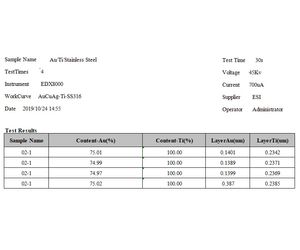
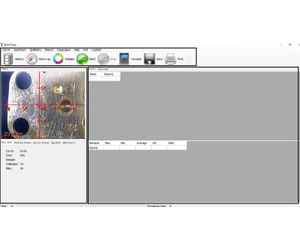
Once XRF data is generated from a sample, software converts X-ray intensity to thickness or composition. The software has two components: spectrum processing and quantitative analysis.
Spectrum processing uses energy calibration, spectrum stabilizing, peak identification, dead-time correction, sum peak correction, escape peak correction, overlap correction, and background removal to extract X-ray intensities from a spectrum.Quantitative analysis calculates thickness and composition from XRF intensities