

- Home
- Companies
- Solarmeter by Solar Light Company, LLC
- Products
- Solarmeter - Model 4.2 - Sensitive UVA ...
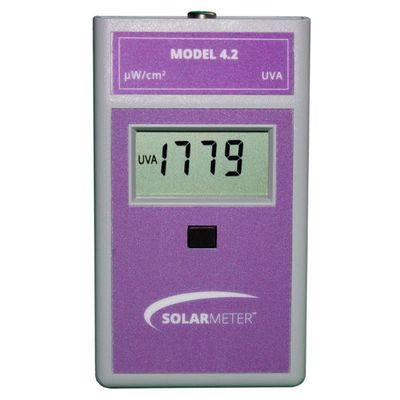
Solarmeter - Model 4.2 -Sensitive UVA Meter
Compact, Handheld, and Durable, Simple Single-Button Operation, NIST Traceable Accuracy, LCD Display, Made In USA.
- Testing Window Film/Tint Transmission
- Monitoring Low Level UV from Household Lamps
- Testing Ground-level UV from Stadium Lighting
- Measuring Outdoor Shady Area UVA
- Choose Sensitive Model 4.2 For Indoor / Low Intensity Applications
- Choose Standard Model 4.0 For Outdoor / High Intensity Applications
Model: 4.2
Irradiation Range: 0-1999 µW/cm² UVA
Response: 320-400 nm UVA
Resolution: 1 µW/cm²
Conversion Rate: 3.0 Readings/Sec
Display: 3.5 Digit LCD
Digit Size: 0.4 (in) / 10.2 (mm) high
Operational Temperature: 32°F to 100°F / 0°C to 37.8°C
Operational Humidity: 5% to 80% RH
Accuracy: ±10% REF.NIST
Dimensions
4.2L x 2.4W x 0.9D (in) / 106.7L x 61W x 22.9D (mm)
Weight: 4.5 (oz) / 128 (g) Including Battery
Power Source: 9-Volt DC Battery
Lens: UV Glass
Diffuser: Teflon
Agency Approval: CE Mark
Sensor
The sensor consists of a GaAsP photodiode and a UV filter. It is completely insensitive to visible light longer than 400nm and infrared radiation, because its spectral response only covers the UVA region from 320-400nm.
Operation
To operate your Solarmeter, aim the sensor window located on the top panel of the meter directly at a UV source. Press and hold the push-button switch on the face of the meter. For best results take note of the distance the reading was taken from the UV source in order to ensure repeatable results. Battery operation voltage is viable from 9V down to 6.5V. Below 6.5V, the numbers on the LCD display will begin to dim, indicating the need for battery replacement. Under typical service load, a standard 9V battery will last approximately 2 years.
- To measure home, business, school or car window UV transmission, take reading through window or film and compare to outdoor reading.
- For household lighting, including compact fluorescents, take reading near lamps and increase distance until reading falls below1 W/cm.
- For gym or stadium lighting, take readings at floor level. Ask to have UV shields installed if readings are too high.
- Do not subject the meter to extremes in temperature, humidity, shock or dust.
- Use a dry, soft cloth to clean the instrument. Keep sensor free of oil, dirt, etc.