


VRB - Technology
An advanced flow field design for increased efficiency and optimized material usage. VRB® Energy`s VRB-ESS® is the most advanced vanadium redox battery technology in the world. Our core technology includes in-house proprietary low-cost ion-exchange membrane and bipole material, long-life electrolyte formulation and innovative flow cell design.
VRB Energy`s technological advancements have dramatically lowered the cost of the core cell stack components compared to previous vanadium flow battery designs. In addition, our electrolyte balancing and shunt current management set us apart from other flow battery providers.
Our fifth-generation cell stack design has an advanced flow field design that optimizes distribution of electrolyte through the cell stacks. This increases overall efficiency and optimizes material usage.
VRB Energy`s proprietary electrolyte formula is engineered for low-cost manufacturing, optimal performance and long-life. While some flow batteries use two different chemicals for the positive and negative sides of the battery, vanadium flow batteries use the same electrolyte on both sides of the battery. This means the batteries are safe and reliable, and there is no harmful corrosion or degradation over time.
Using the multiple valence states of vanadium to store and release charges, enables nearly unlimited charge / discharge cycles of the battery, and there is no risk of combustion or thermal runaway.
Customers can be assured that VRB-ESS® enables a safe, consistent, high storage capacity that lasts a lifetime.
VRB-ESS® systems are composed of two main components.
VRB-ESS® cell stacks that are the heart of our systems, and the electrolyte stored in external tanks that flows through our systems.
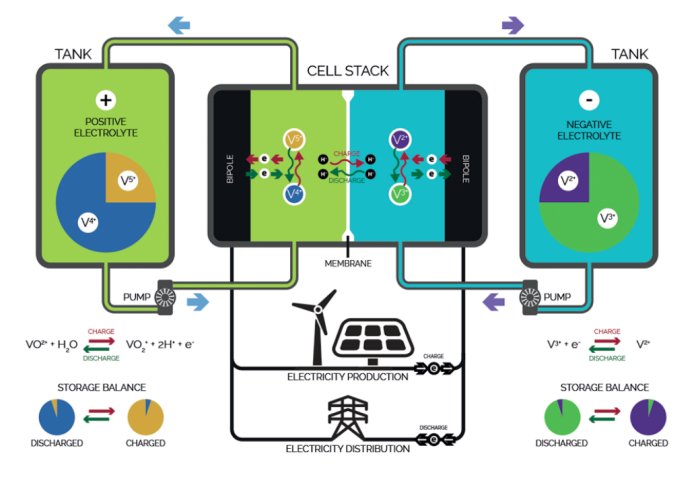
The cell stacks are what determine the power (MW) rating of our systems. The standard VRB-ESS® power module is rated at 250kW for MW-Class systems. These power modules are combined with electrolyte storage tanks and power conversion systems (PCS) to form systems from 250kW / 1MWh.
The amount of electrolyte is what determines the energy (kWh or MWh) rating of our systems. With the cell stacks (MW) separate from the electrolyte (MWh) our systems are able to be sized to best meet the needs of our customers.
Adding extra energy (MWh) to a system is accomplished by adding tanks and electrolyte, which yields a lower marginal cost and greater flexibility in sizing or expanding a system.