


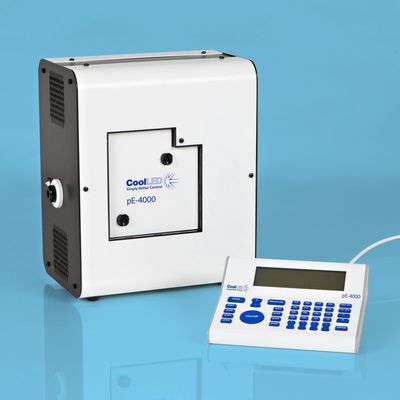
Model pE-4000 -Universal Illumination System
The pE-4000 sets the standard as the universal Illumination System for fluorescence microscopy. The system has 16 selectable LED wavelengths across four channels that can be finely controlled and matched to the filters and fluorophores of almost any microscope, making it the broadest and most versatile illumination system available. The CoolLED pE-4000 benefits from our award winning sustainable Green technology and delivers enhanced irradiance at the sample plane with a significant reduction in energy consumption, and is supplied with a 36 month warranty.
The pE-4000 is a powerful, flexible, controllable system for advanced research applications.
“Striking, bright fluorescence images with a strong signal to noise ratio even when using a low magnification objective”
Graham Wright, Institute of Medical Biology, A*STAR Singapore
Multiple levels of control are possible, from simple to advanced. A dual mode control pod gives immediate manual control in either White or Advanced modes, where individual LED channels can be individually switched on/off or irradiance modulated.
Alternatively, the USB interface and integration into major microscope software platforms allows complex software control.
TTL control enables capturing high-speed events (<1 ms). Since there is no shutter or filter wheel, without these moving parts, this reduced latency means speed is limited only by the camera. An expansion box is also available for added functionality with multiple BNC connections for remote analogue and TTL control.
For optogenetics applications, alongside the ability to include excitation filters to tune the wavelength to the opsin’s maximum activation peak, an internal function generator controls pulse timing and waveforms.
Improving cell viabilityWith the pE-4000, it is now possible to prevent artefacts and allow live samples to thrive in experiments >100 hours. Fine control of illumination timing and irradiance with TTL and the function generator minimises exposure, avoiding photobleaching and phototoxicity.
“When you can only control the intensity of ‘white’ light (rather than individual channels), the level of photobleaching can be high. With the pE-4000, we can control the excitation of the individual channels. It is possible to optimise the excitation irradiance according to the labelling, greatly reducing photobleaching and phototoxicity in a live experiment.”
Dr Yan Gu, University of Sussex
“Suddenly, we were able to offer users uninterrupted extended live cell experiments of 100+ hours, without worrying about brightness fluctuations, lamps burning, room heating, etc. Also, users have reported markedly reduced bleaching and phototoxicity in their samples, both from the prokaryotic and the eukaryotic research fields.”
Dr Jens Eriksson, Oslo University Hospital
Matching diverse fluorophore requirementsFull filter compatibility and 256 wavelength combinations from 16 installed LEDs (365 nm -770 nm) covers all available fluorophores, which is ideal for multi-user facilities or evolving experimental needs.
Multi-channel experiments with no pixel shiftUp to four channels using distinct wavelengths can be captured with no mechanical movement, preventing pixel shift and allowing the direct comparison of data as in the following experiment:
(A) Representative photocurrent traces of a PhobosCA expressing CA1 cell evoked with different activation wavelengths and shutoff with 595 nm light. (B) Photocurrent traces in the same cell evoked with 460 nm light and shutoff with indicated wavelengths (10 mW/mm2).1
Increased power efficiencyThe pE-4000 includes 16 LEDs grouped into four individually controllable channels, and this unique Wavelength Grouping Concept makes it possible to deliver more power in an efficient four-channel system. As the first company to introduce LED microscope lighting for fluorescence microscopy, CoolLED has developed a comprehensive understanding of the complexities of configuring and selecting filter sets for experiments using multiple fluorophores. CoolLED’s innovation comes from recognising that all the fluorophores used in multi-band work can have their absorption bands divided into four separate groups across the spectrum due to the restricted bandwidth available.
DAPI/FITC/TRITC/Cy5 Quad filter excited by pE-4000 at matched wavelengths shown above.
A choice of 16 LEDs enables the user to select the optimal excitation wavelength for each fluorophore combination and optical filter configuration, which enables maximum performance and flexibility. Our Filter Finder tool provides more information on recommended filter configurations.
- Broadest LED spectrum available: 365-770 nm, with 16 LEDs
- Four channel wavelength-grouping design matches most commercially available dual, triple, and quad filters
- Removable inline excitation filter holders: no moving parts for fast acquisition
- Internal function generator for electrophysiology and optogenetics applications
- TTL and USB interfaces with major imaging software packages allows incorporation into all experimental parameters
- Analogue inputs for dynamic irradiance control
- Individual control of selected LED wavelengths reduces background
- Rapid switching between LED wavelengths enables capture of high-speed events
- Instant on/off: No shutters required, no warm up or cool down
- Stable and repeatable: reliable and consistent results
- Precise irradiance control in 1% steps (0-100%): no ND filters required
- Pre-sets allow lab manager to match white spectrum to existing filter cubes
- Simple to fit, simple to use: no alignment, a once only adjustment
- Wide range of microscope adaptors: fits most microscopes
Plus all the benefits of LED technology.
The system comprises a pE-4000 Light Source, Control Pod, liquid light guide, Universal Collimator and Power Supply.
Control
Manual:
Dual function remote manual control pod for White mode or Advanced mode
Remote:
Via USB for independent on/off and irradiance control of each channel. Triggering speed approximately 10-20 ms
Via 4 TTL inputs for independent on/off control of each channel. Triggering speed <20 µs
Via single TTL for on/off control of manual or software selected channels
Via 4 analogue inputs 0-10 V, 0-300 kHz for dynamic control of irradiance from external analogue signals
Sync Out:
4 TTL outputs for each channel – active high 1 TTL output for any channel – active high
Programmable interface:
4 TTL outputs for on/off control of peripherals (transmitted illuminators, stages etc.) 4 analogue outputs for irradiance control of peripherals (can be programmed to mirror LED irradiance levels for channel control) 0-10 V full scale.
Function Generator:
Internally generated sine, pulse and ramps for each channel programmed via control pod.
Connectivity:
USB (B type) for PC connection. All other TTL and Analogue inputs/outputs via 25-way ‘D-type’ female connector (optional rear mounting pE-Expansion Box available for BNC connectivity).
Imaging Software:
Recognised under common software e.g. Micromanager, MetaMorph, cellSens, NIS Elements, etc. see Imaging Software
Choosing configurations
The pE-4000 can be configured to deliver light to the microscope via liquid light guide or fibre. Liquid light guides can be used in conjunction with CoolLED’s pE-Universal Collimator which can accept a microscope adaptor from CoolLED’s extensive range. Find out more here.
Specification
Power requirements
110-240 V a.c. 50/60 Hz
Power consumption
Standby (i.e. no LEDs on) : Max 7 W
Single wavelength operation : Max 25 W
Dual wavelength operation : Max 44 W
Triple wavelength operation : Max 53 W
Quad wavelength operation : Max 60 W
Dimensions
pE-4000 Light Source: 150 mm(w) x 22 0mm(d) x 260 mm(h) – Weight 3.5 kg
pE-4000 Control pod: 154 mm(w) x 135 mm(d) x 40 mm(h) – Weight 0.95 kg
pE-4000 Power Supply: 164 mm(w) x 64 mm(d) x 35 mm(h) – Weight 0.58 kg
pE-Expansion Box: 151 mm(w) x 18 mm(d) x 95 mm(h) – Weight 0.34 kg
Environment and Safety
- Mercury-free and Laser-free
- Energy Efficient
- Long lifetime
- No bulb replacements
- Reduced risk of eye damage
- Quiet operation
- No special disposal regulations or issues
Warranty
Industry-leading 36 months. Read more here.
All data correct at time of publication