


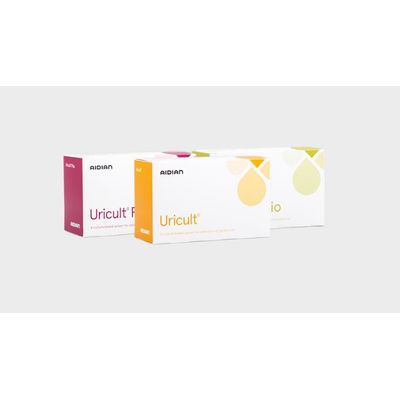
Uricult Tests
Uricult tests are available in three different, easy-to-use versions.
The Uricult dipslide is based on two agar media. The CLED agar is intended for determining the total bacterial count in urine samples and the selective MacConkey agar supports the growth of gram-negative bacteria.
The Uricult Plus dipslide is based on three agar media. In addition to the CLED and MacConkey agar media, Uricult Plus has a selective Enterococcus medium which is intended specifically for the detection of enterococci.
The Uricult Trio dipslide is based on three agar media. In addition to the CLED and MacConkey agar media, Uricult Trio has a selective E.coli medium which is intended specifically for the detection of gram-negative, β-glucuronidase-producing organisms, of which E. coli is the most common in urinary tract infections.
Uricult tests provide you with- Easy to perform on-site testing: Dip - Incubate - Interpret
- Convenient way to transport urine samples: Inoculated dipslide can be inserted back into the tube and sent to the laboratory
- Easy and suitable UTI testing for everyone - also for personnel not trained for laboratory work
- Fast results in 16-24 hours for more information on clinical status
- Stability of six to nine months at room temperature
Test results should never be used alone, without a complete clinical evaluation.
Products available: 67404 Uricult, 10 tests
67465 Uricult Plus, 10 tests
68197 Uricult Trio, 10 tests
Use: For in vitro diagnostic use
Method: Culture
Sample type: Urine
Time to result: 16 - 24 hours
Reading of the result: Visual
Storage: 7 - 25 °C
Additionally needed: Incubator capable of +36 ± 2 °C
Note: Store in an area protected from air and temperature fluctuations. Do not allow to freeze.
Country of origin: Finland
Registration: Not registered in the USA
Registered trademark: Uricult is a registered trademark of Aidian Oy
Urinary tract infection (UTI) is one of the most common infections caused by bacteria1. It is important to verify and treat UTI adequately since untreated UTI may cause kidney damage. Bacterial culture of an appropriately collected and handled urine sample can provide an accurate diagnosis. However, transportation of urine samples from the sample collection site to a laboratory may lead to incorrect results as bacteria may multiply if the samples are not transported correctly2.
The Uricult tests are dipslides for culturing urine samples. The slides are covered on both sides with agar media, two or three media depending on the test. The slide can be dipped into urine, or urine can be poured onto the slide. Thereafter, the inoculated slide is inserted back into the tube, making it ready for incubation or for transportation. After incubation, the presence of bacteria is evidenced by colonies growing on the agar surface. The number of colonies indicates the number of colony forming units (CFU/ml) in the urine sample because each colony is the result of multiplication of a single bacterial cell.
The total colony count on all Uricult tests is determined from the originally green CLED agar by matching the colony density with the model chart. The bacteria may be classified as lactose fermenting or non-lactose fermenting bacteria based on their appearance on CLED agar. The number of gram-negative bacteria can be determined for all Uricult tests from the originally brownish–red, selective MacConkey agar.
In the Uricult Plus test, the colourless medium is selective for enterococci. It helps to differentiate enterococci that grows in various shades of red on the medium. Also group B streptococci may grow on this medium in small colonies.
In the Uricult Trio test, the colourless chromogenic E. coli medium is selective for β-glucuronidase-producing organisms. Especially E. coli grows in various shades of brown or grey on this medium. With this combination of three different media, Uricult Trio is a highly reliable tool for the identification of E. coli directly in primary urine cultures3.
The predominant uropathogenic gram-negative bacterium that is causing 80 % of uncomplicated UTI cases is E. coli4. The other bacteria commonly causing UTIs are Staphylococcus saprophyticus (10-15 %), Klebsiella, Enterobacter, and Proteus species.