


- Home
- Companies
- Hortus s.r.l.
- Products
- Hortus - Model HMS-Meteo Series - ...
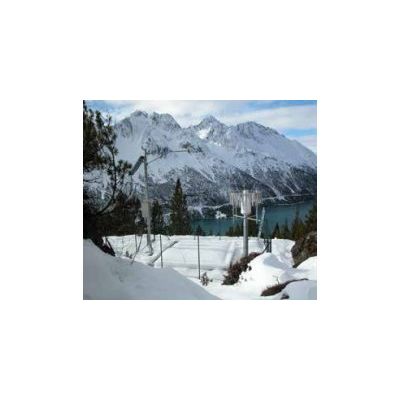
Hortus - Model HMS-Meteo Series -Weather Stations
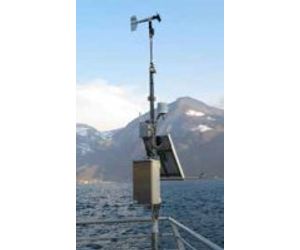
Weather stations fully customized to meet the customer requirements and made to work in critical environment conditions. Main features: high performing datalogger (Campbell Scientific, DataTaker), equipment and GPRS data transmission reliability, quality and and accuracy of installed sensors, low power consuption, able to use sensors available on international market. Also available in a specific version for high altitude, HMS-METEO3000.
- Stainless steel IP66 enclosure, with welded stainless steel brackets for mounting to pole
- Data acquisition system based on Campbell Scientific CR1000 with enhanced software programming and automatic GPRS transfer of data
- SIERRA Wireless Xtend modem GSM/EDGE with GSM antenna
- 60W photovoltaic power supply kit with stainless steel brackets for mounting to pole and 40Ah GEL battery
- Multiplexer + 24Vdc voltage regulator + CV120 relay module, to manage sensor supply metereological sensors
- WSN system (spatially distributed autonomous sensors)
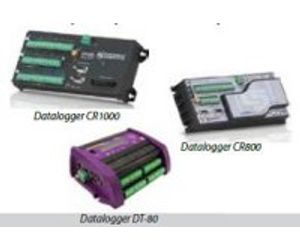
HMS-METEO data acquisition system based on different data-logger:
- Campbell Scientific CR-series
- DataTaker DT-8x series
Is convenient to use multiplexer to increase the number of sensors connected to a data-logger by signal cables, and there are several possible configurations to maximize the type and the number of sensors connected to a single data-logger. Each type of datalogger can support different multiplexer (see table below).
A wireless sensor network (WSN) consists of spatially distributed autonomous sensors to monitor environmental parameters, and to cooperatively pass their data through the network to a gateway node.
The WSN is built of nodes, and each node is connected to one (or sometimes several) sensors. Each sensor network node has typically several parts: a radio transceiver with an internal antenna or connection to an external antenna, a microcontroller, an electronic circuit for interfacing with the sensors and an energy source, usually a battery or an embedded form of energy harvesting.
The topology of the WSNs can vary from a simple star network to an advanced multi-hop wireless mesh network.
In HMS-METEO series it’s possible to configure 3 types of WSN system, made by different producers; each has its specific potentials, to be considered on an individual basis.
Meteorological (and related environmental and geophysical) observations are made for a variety of reasons. They are used for the real-time preparation of weather analyses, for the study of climate, for hydrology and agricultural meteorology, and for research in meteorology and climatology. HMS-METEO systems are able to integrate sensors produced by the major international manufacturers, compliant to WMO advices.
HMS-METEO stations can be used as meteorological support for HMS-GEO and HMS-HYDRO systems. Some sensors supported by HMS-METEO can be managed in a WSN system.
A lot of accessories are available to customize your HMS-METEO system.
- Enclosure: a large selection for all installation requirements.
- Supply: to ensure correct “energy charge” to the system.
- Stainless steel supports: reliability and durability guaranteed for all types of installation.
- Electrical components: to drive better all the sensors and optimize energy consumption.
- Installation and maintenance: specialized assistance from Assembly to Z.