


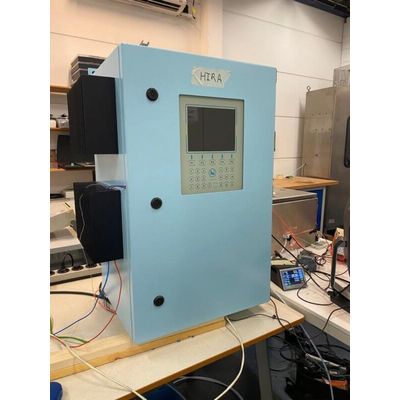
Model Raman -Zero Emission Analyzer Concept
In corporation with TNO (the Netherlands Organization for applied scientific research) in Delft, Hobré developed a very robust and innovative, patented Raman technology for online gas analysis in the oil and gas industry, including renewables. With the Raman technology Hobré offers a fast responding gas composition analysis for feed forward control on high- and low-pressure applications. The combination between the Hobré Raman technology and Hobré’s proprietary HIFISC probe design results in an unmatched Zero-Emission setup. The initial focus for Hobré will be on (renewable) natural gas and syngas applications (such as Methanol, Ammonia and Hydrogen production).
- Complete natural gas (incl. H2) analysis in 10 seconds.
- Non-destructive measurement. Analyzed sample is returned to process.
- No pressure reduction required. High pressure has a positive effect on the Raman signal.
- Flow and pressure independent.
- High pressure and temperature flow cell for analysis at process conditions.
- Separation between sample and electronics by use of optical fibers.
- No need for frequent calibrations.
The Hobré Raman can simultaneously measure C1..C5+, N2, H2, CO, CO2, H2O in gases. Technologically wise, the Hobré Raman is a big step forward as it offers a combination of features not available in any other analyzer on the market, e.g.:
- High accuracy compositional analysis in 10 seconds,
- No moving parts,
- Full separation of detector and electronics,
- Wide concentration range,
- Zero-emission design,
- Lowest lag time and nearly zero dead volume,
- Suitable for high pressure application, without the need for pressure reduction,
- Close to zero maintenance and low spare component costs,
- Only power and purge air are required,
- Hydrogen measurement as a standard (0-100% range) makes it “future proof”,
- Output of physical properties like heating value, Wobbe Index, density, specific gravity, heat ratio Cp/Cv, compressibility, air demand.
The analysis is based on the Raman measurement principle and named after its discoverer, the physicist C.V. Raman. Raman spectroscopy is
a nondestructive, fast responding measurement principle that provides chemical information on the sample being analyzed. This technique allows users to obtain (near) real time information on the composition as well as physical properties which can be used to optimize efficiency based on a feedforward control loop.
Light interacts with materials in different ways (transmitting, reflecting or scattering). Raman looks at scattered light. A continuous wave type laser is focused into a measuring cell through a spherical lens.The scattered light is detected by a spectrometer. Most of the light that scatters remain unchanged in energy (Rayleigh Scattered). A small fraction of the scattered light will lose or gain energy. This fraction is referred to as Raman scattering.
The change in energy depends on the vibration frequency of the molecule. Light atoms have strong bonds and a high frequency, resulting in a significant change in energy. Heavy elements (low frequency, weak bonds) show a small change in energy. The energy difference between the two states is unique and can be used for both identification of an element and quantitative analysis.