


- Home
- Companies
- AMTI Force Measurement Systems
- Services
- Force Plate Installation Services
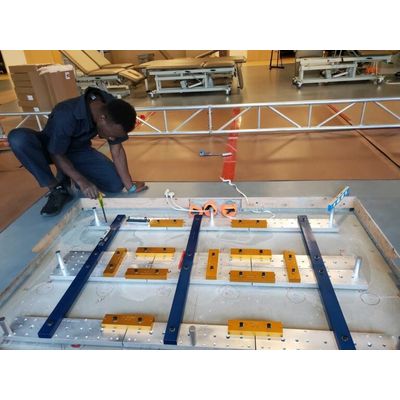
Force Plate Installation Services
AMTI offers specialized installation services for force plates, which are crucial in ensuring precise force measurement. The installation process is meticulous to minimize vibration interference from buildings or the ground, which can affect signal outputs. This is achieved by securing force plates to flat surfaces bonded to solid structural foundations, like ground-level concrete slabs. AMTI's Modular Rail System includes precision-machined aluminum rails bonded to concrete floors for flexible configurations. For installations, two key methods are employed: Recessed Pit Installation, leveling the force plate with the surrounding floor, and Raised Installation, for circumstances where recessed pits are impractical. AMTI provides technical drawings and installation consultations, but requires pre-approved foundational work by external vendors. Their technicians are skilled in laying and leveling mounting rail arrays, securing plates, running cables, and configuring amplifiers to meet specific laboratory requirements.
Explore the additional services we offer to support and maintain our industry-leading force measurement and testing devices.
Installation
Force plates are sensitive test instruments. As such, it is strongly recommended that all strain gage platforms be mounted, when possible, in a manner that minimizes the effects of building or ground vibrations on the signal output.
Mounting is best accomplished by securing the force plate to a flat surface that is bonded to a solid structural foundation, such as a ground-level concrete slab. AMTI’s unique Modular Rail System uses precision-machined aluminum rails adhesively bonded to a concrete floor, with pre-drilled mounting holes to afford our customers more flexibility in their force plate configurations.
Recessed Pit Installation
Recessed (Concrete) Pit Installations are the most common method of mounting force platforms such that the working surface of the force plates is level with the surrounding floor. AMTI engineers have developed detailed drawings to outline the considerations for designing a recessed pit to accommodate a wide variety of force plate layouts, which include:
- Dimensions of the pit (Length x Width x Depth)
- Flatness/levelness of pit base and upper perimeter
- Conduit for cables
A second popular installation method is a Raised Installation. This method is often used when a recessed pit is not possible, such as on a second-floor lab space. In this method, the force plate is mounted on top of the concrete floor and the surrounding floor, or a walkway, is built up to be flush with the force platforms.
Installation considerations include:
- Flatness/levelness of concrete floor
- Computer flooring or custom-built surround platform (sourced and installed by customer or vendor of choice)
- Route for force plate cables