

Municipal Solid Waste Processing and Materials Recovery
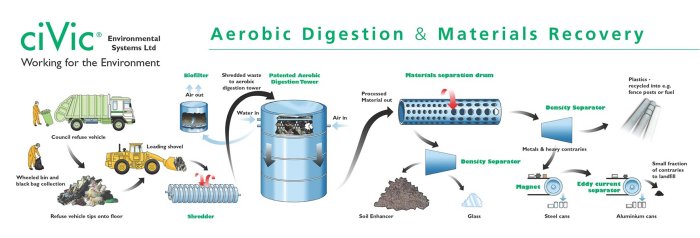
The ciVic process starts with the delivery of municipal solid waste, which is deposited from the refuse collection vehicle into the reception hall. Waste is then fed by a mobile loading shovel into a shredder, which breaks up bags of waste and reduces the size of the waste material. The shredded waste is then conveyed into the top section of the ciVic digestion tower.
Each batch of material is processed in a closely controlled environment with all critical parameters being constantly monitored and used to control the agitation of the material and addition/extraction of air as required.
The waste is kept under these tightly controlled conditions for 6-10 days, during which time the biodegradable content (paper, food waste, grass cuttings etc) is rapidly digested to form compost, water vapour and carbon dioxide. The system is completely closed, allowing total control of the carbon dioxide produced - this is passed through a bio-filter to ensure that no odours escape.
A major advantage of the ciVic system is that every element important in the process is constantly monitored and controlled all the time. All elements and operations are recorded by the bespoke Supervisory Control And Data Acquisition SCADA system and logged for each individual batch. This provides a complete history showing the batch identity, batch size, water additions residence time/temperature achieved and any other significant details. All of which can be formatted to the operators requirements to enable full compliance with both the Animal By Products Regulations and the operators own quality control system.
Following digestion, the materials are automatically separated to the various fractions for recycling and/or use. Only a small proportion of residual materials are required to be disposed of to landfill.
The ciVic process delivers:
- Production of soil improver material
- Separation of ferrous material
- Separation of aluminium cans
- Separation of plastics for recycling
- Separation of glass
- >80% diversion from landfill
- The biodegradable portion of the waste is completely diverted from landfill; therefore even the final diversion targets in the Landfill Directive can be met.
- The approach is consistent with Government targets for sustainable waste management practice.
- Manual handling of waste, such as would be required in a Materials Recycling Facility for co-mingled domestic recyclable materials, is avoided. This significantly improves the health and safety and environmental conditions for the plant operatives.
- A much higher rate of recycling is achievable from MSW with the ciVic process rather than a conventional clean MRF.
- Organic waste, plastics, glass and metals are all extracted for recycling without incurring any additional transport emissions for segregated collection.
- There are a range of potential re-use applications for MSW derived soil improving material, many of which are, in themselves, environmentally beneficial, e.g. land remediation of spoil heaps, disused colliery sites etc.
- The composting waste is sanitised to a temperature time profile that kills pathogenic micro-organisms. A micro-processor controlled monitoring system provides a quality assurance step for every batch of compost that is produced, as well as allowing control of the processing regime.
- The ciVic process operates on the principle of aerobic digestion and as a result the by-products are carbon dioxide and water. These are much less harmful to the environment than methane produced from anaerobic digestion, or the products of combustion produced by an incinerator.
- Since >90% of segregated wastes are diverted from landfill, the ciVic system offers insulation from the effects of rising landfill tax.
- Composting of paper packaging is ‘reprocessing’ according to the EA’s Statutory Guidance, therefore an in-vessel composting plant may benefit from revenue generated by issue and sale of Packaging Recovery Notes (PRN`s).
- The success of most Material Recycling Facilities is dependent upon the quality of feedstock: poor segregation increases the costs of operating the MRF and can reduce the value of recyclate extracted. Taking the whole waste stream allows the ciVic process to avoid this risk.
- The ciVic process eliminates reliance on the highly volatile secondary materials markets, especially the paper market, as it produces a more generic product that can be supplied into several markets within which there is predicted to be a long-term demand.
- The ciVic system is a proven, viable alternative to incineration and, because the system is modular, tonnages from <10,000 to >120,000 tonnes per year can easily be accommodated.
- Because of its modular design, the ciVic system can readily accommodate fluctuations in demand throughout the year. This makes it highly suitable for areas with a ‘floating’ population i.e. coastal areas.
- The ciVic system is environmentally friendly and can easily fit on to an existing waste transfer station or industrial site, complying with the proximity principle, reducing expensive transport costs and minimising emissions to atmosphere.