

- Home
- Companies
- MtoZ Biolabs
- Services
- MtoZ Biolabs - PhIP-Seq Autoantibody ...
MtoZ Biolabs - Model phip-seq-autoantibody-profiling-service -PhIP-Seq Autoantibody Profiling Service
Autoimmune disease research often involves broad and heterogeneous antibody responses, while the relevant autoantigens may not yet be fully defined. Targeted immunoassays remain useful when a limited set of established antigens needs to be examined, but they may provide limited coverage during exploratory studies.
Phage Immunoprecipitation Sequencing, or PhIP-Seq, provides a discovery-stage approach for profiling antibody reactivity across phage-displayed peptide libraries. It can support broad candidate screening, comparison of antibody reactivity patterns between study groups, and prioritization of candidate linear epitope-containing regions for follow-up research.
1. Comparative Autoantibody Profiling
PhIP-Seq may be used to compare autoantibody reactivity profiles between autoimmune disease cases and healthy controls, disease-control groups, or other biologically relevant populations. It can also support analyses across disease subtypes, activity states, clinically defined immune phenotypes, treatment groups, or longitudinal time points.
2. Discovery-Stage Candidate Screening
The service may be useful when relevant antibody targets remain uncertain or when initial targeted assays provide limited antigen coverage. PhIP-Seq can help identify candidate antibody-reactive peptides mapped to self-proteins, together with candidate linear epitope-containing regions, for subsequent biomarker research, mechanistic studies, or targeted validation.
1. Antigen Library Selection
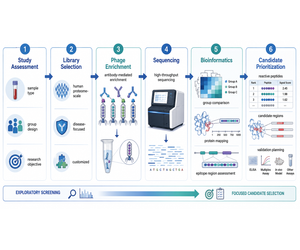
A human proteome-scale peptide library may be appropriate for broad exploratory studies, while disease-focused or customized coverage can be evaluated when a project involves defined antigen classes, protein families, or specific biological hypotheses. Library selection should support both initial screening and practical downstream interpretation.
2. Integrated Analysis Workflow
The workflow includes sample and study-group assessment, peptide library selection, antibody-mediated phage enrichment, high-throughput sequencing, and peptide-level bioinformatics analysis. Result interpretation can include group comparison, protein mapping and annotation, candidate linear epitope-containing region assessment, and candidate signal prioritization.
1. Reactivity Profiles and Candidate Signals
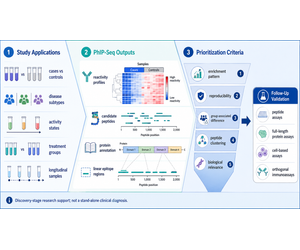
Results may include sample-level or group-level autoantibody reactivity profiles, candidate antibody-reactive peptides mapped to relevant self-proteins, protein annotations, candidate linear epitope-containing regions, and group-comparison results. Where adjacent or overlapping peptides show related enrichment patterns, these findings may help identify regions suitable for follow-up investigation.
2. Candidate Prioritization
Candidate signals can be prioritized according to enrichment patterns, reproducibility, group-associated differences, peptide clustering within a source protein, and biological relevance to the study question. These findings are intended to provide research leads rather than stand-alone clinical diagnoses or definitive confirmation of disease-associated autoantibodies.
1. Study Assessment
Before project initiation, sample type, sample condition, group design, antigen library needs, and research objectives can be evaluated. Serum and plasma are commonly used for antibody profiling, while other antibody-containing sample types can be assessed according to project requirements.
2. Validation-Oriented Support
PhIP-Seq is positioned as a discovery-stage screening and candidate-prioritization method. Candidate findings can be incorporated into a follow-up strategy using suitable peptide-based assays, full-length protein assays configured to preserve relevant antigenic context, cell-based assays, or other orthogonal immunoassays, depending on the nature of the target and the biological question.
PhIP-Seq Autoantibody Profiling Service helps autoimmune disease researchers move from broad antibody response screening toward a focused set of candidate peptide and antigen-related signals. MtoZ Biolabs can support antigen library strategy, sample evaluation, candidate prioritization, and validation-pathway planning based on the specific research objective.
MtoZ Biolabs is an integrate contract research organization (CRO) providing advanced proteomics, metabolomics, bioinformatics, and biopharmaceutical analysis services to researchers in biochemistry, biotechnology, and biopharmaceutical fields. The name of MtoZ represents “mass to charge ratio” in mass spectrometry analysis, as most of our services are provided based on our well-established mass spectrometry platforms. Our services allow for the rapid and efficient development of research projects, including protein analysis, proteomics, and metabolomics programs.
MtoZ Biolabs is specialized in quantitative multiplexed proteomics and metabolomics applications through the establishment of state-of-the-art mass spectrometry platforms, coupled with high-performance liquid chromatography technology. We are committed to developing efficient, and effective tools for addressing core bioinformatics problems. With a continuing focus on quality, MtoZ Biolabs is well equipped to help you with your needs in proteomics, metabolomics, bioinformatics, and biopharmaceutical research. Our ultimate aim is to provide more rapid, high-throughput, and cost-effective analysis, with exceptional data quality and minimal sample.
Email: [email protected]