


- Home
- Companies
- Earth Science Analytics (ESA)
- Software
- Ai Seismic Properties
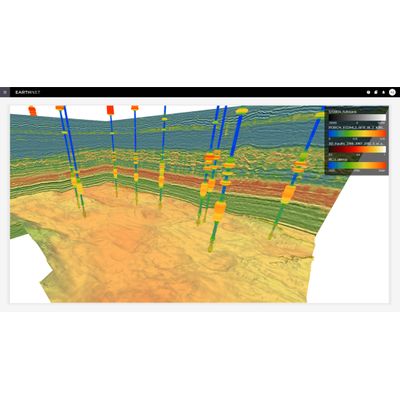
Ai Seismic Properties
AI-powered data analytics tool for predicting reservoir properties. EarthNET AI Seismic properties lets you propagate knowledge from the well to seismic scale to predict reservoir properties from elastic properties generated from well data, either as a function of 3D partial stacks, or as a function of partial-stack cubes.
With EarthNET Seismic properties, you can train models to predict many different properties from seismic, including vp, vs, vp/vs, density, acoustic impedance, lithology, porosity, vclay, permeability, water saturation, and more. The property you want to predict needs to be represented in the form of a well log, and there should be a discernable relationship between the property and the seismic data that can be learned during the model training process.
You get access to a large number of deep learning model architectures in EarthNET including neural networks such as Unet’s and transformers. We ensure that we keep up with the latest advancements in ML architecture and provide you with the most advanced and accurate models.
Since seismic data has a coarse sampling interval, whereas well data has a fine sampling interval, you need to scale the well data to the seismic data.
The scaling functionality in EarthNET ensures that the detail level between the 3D volume features and the well log responses are comparable.
Seismic data is recorded in time (TWT) whereas well data is recorded in depth (MD). In order to use well data in combination with seismic data, we need to ensure that both datasets are aligned. EarthNETs 'seismic well tie tool lets you quantify this time-depth relationship.
Review and compare model results and performance metrics for multiple models to identify the models that perform best for your tasks.
All your trained ML models will be stored in your model library, along with all the metadata that describes the training data used, the model architecture, parameters, and results. With full information about each model, you can quickly identify potential causes for suboptimal performance, mitigate them and re-train the model.