

Machine Learning with Python Extensions
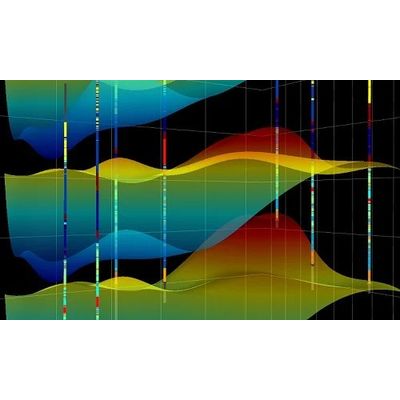
Save time and resources with Machine Learning. PowerLog can connect to any open-source distribution of Python and perform in-house advanced processing to save your company time and money. You can successfully apply machine learning and deep learning techniques with this tool including: Facies classification, supervised and unsupervised, Unbalanced sampling algorithms to eliminate bias, Data loading, analysis, and migration, Automated log editing for outlier detection, synthetic curve generation, and automated curve substitution
-
Machine learning in PowerLog Python Extensions enables clearer reservoir understanding and faster, more efficient data analysis so you can:
- Predict curves based on existing log data
- Correlate core analysis to log data
- Model complex porosity and permeability relationships
- Quickly edit logs for data conditioning with automated tools
Introduced to the oil and gas industry more than 35 years ago, PowerLog has evolved to become one of the most user-friendly yet sophisticated solutions available.
Powerful Collaboration
Efficient multi-user functionality lets petrophysicists analyze the logs, geologists pick tops, and engineers create zones for an integrated reservoir characterization workflow.
Proven Technology
PowerLog is the benchmark for petrophysics, rock physics, facies analysis and statistical mineralogy. It shares a common data model (CDM) with Jason® Workbench and EarthModel® FT.
Fast Petrophysical Analysis
Easily make changes when you see a problem in a logplot or histogram. All changes are immediately reflected everywhere the affected data appears.
Machine and Deep Learning
Solve your toughest petrophysical challenges with machine learning and deep learning techniques for supervised and unsupervised facies classification, data loading, analysis and migration, and more.
Customizable and Extensible Petrophysics
Go beyond PowerLog’s standard capabilities through user programming and optional integrated products. APIs are available for VB.Net that let you create custom interpretation routines, call specialty algorithms, and integrate with other software and other tasks.