

- Home
- Companies
- HH Engineering & Service GmbH
- Software
- Selective Catalytic Reduction Software
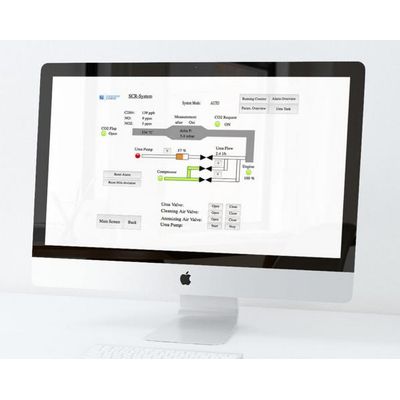
Selective Catalytic Reduction Software
The SCR method is intended to control the NOx emissions by means of a selective catalytic reduction. The SCR method is intended to control the NOx emissions by means of a selective catalytic reduction. This is the most common method
for removal of NOx in combustion engines and non-engine combustion processes (biomass, glass furnace, SNCR-SCR combination, industrial boilers).
What is SCR and how does SCR work?
SCR = Selective Catalytic Reduction
This is injected in the exhaust gas where it evaporates and releases NH3 – ammonia. On the SCR catalyst surface the reduction occurs
and converts the NOx to harmless N2 which is inert and a natural component of the air. The equally harmless H2O is a by-product.
What chemical reactions are behind the SCR technology?
Nitrogen oxides are converted to inert, non-toxic gas components with the help of a reducing agent. The catalyst reduces
the amount of energy which is necessary to allow the reaction to proceed under the given temperature conditions.
With the SCR technology, the nitrogen monoxide is reduced by ammonia and oxygen to nitrogen and water:
4NH3 + 4NO + O2 → 4N2 + 6H2O
The reaction also takes place in the significantly slower reaction without oxygen:
4NH3 + 6NO → 5N2 + 6H2O
However, most of the exhaust gases contain an excess of oxygen, so this reaction is hardly relevant. If the two
nitrogen oxides NO and NO2 are equimolar, the fastest of the reactions will take place:
4NH3 + 2NO + 2NO2 → 4N2 + 6H2O
Depending on the thermodynamic equilibrium and oxygen content, however, there is usually an NO content greater than 90%,
so that this reduction also plays a subordinate role. In particular, vanadium, pentoxide-tungsten, dioxide-titanium, dioxide catalysts
are used, since these can be produced as full extrudates in different cell densities.
Depending on the space velocity (≈ 10000 h-1), pressure loss and temperature, the geometry and vanadium content are adapted
to the respective application
Our H+H SCR systems are suitable for operating temperatures between 180 and 540°C. The catalytic converter must be operated at a minimum temperature, but must not exceed the maximum. While the minimum temperature depends on the sulfur content, the maximum temperature is based on the thermal limit of the catalyst. The minimum temperature is a design criteria and an important parameter for the NOx conversion. The lower the temperature, the more catalyst is needed.
The operating temperature for combustion engines (gas / diesel / heavy oil) is at least
260-320°C and at most 540°C.
The H+H SCR systems require at least 180° C for non-engine combustion processes (biomass, glass furnace, SNCR-SCR combination, industrial boilers).
Which catalysts do we use for our H+H SCR plants?
For our H+H SCR systems we use SCR and oxidation catalysts.