


Triangle Ltd
- Home
- Companies
- Triangle Ltd
- Articles
- Case Study, Colnbrook Leachate Plant.
Case Study, Colnbrook Leachate Plant.
Sep. 25, 2008
Courtesy ofTriangle Ltd
Triangle Ltd was contracted in 2008 by Biffa Waste Services at Colnbrook, Heathrow to resolve the problem of the landfill leachate borehole pumping system failing to deliver acceptable volumes to the SBR leachate plant. Initially they were achieving a maximum of 110m³/month during the fill/aerate treatment phase.
Most popular related searches
borehole pumping system
borehole pump system
landfill leachate
leachate
borehole pump
borehole pumping
pump system
borehole camera
pressure transducer
level sensor
An initial assessment revealed problems with damaged ring main cabling, severe volt drop on the SELV control, poor earthing (flooded control panels not tripping!), absence of check valves, water ingress to distribution panels, failed transducers (replaced with Hawker level sensors), and software issues.
On re-commissioning the flows increased to 450m³/month over the same fill periods.
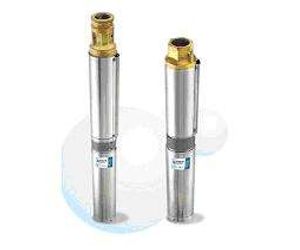
For the second phase of the project, commissioned in September 2008, Caprari submersible pumps were installed and fully integrated to the existing system.
After the management system was re-configured with new software, record volumes are being achieved
Useful Info:
1. To achieve the best performance from any borehole instrument, you must make sure that the sesnor electronics, its casing and the power supply share a common, local ground, and all that all power and data lines are adequately proteced against lightning and other transients.
2. In an dry sand-filled borehole, or one with a non-conducting casing, you will need to ensure the equipment is grounded by other means. the best option is often to attach the sensor housing to an earth line brought out to the surface and attched to a metal stake driven into the ground nearby.
3. Pressure transducers are useful when monitoring depth, but are often not very successful with Landfill Leachate wells. In this case, the Hawker P4 probe has proved to be reliable.
1. To achieve the best performance from any borehole instrument, you must make sure that the sesnor electronics, its casing and the power supply share a common, local ground, and all that all power and data lines are adequately proteced against lightning and other transients.
2. In an dry sand-filled borehole, or one with a non-conducting casing, you will need to ensure the equipment is grounded by other means. the best option is often to attach the sensor housing to an earth line brought out to the surface and attched to a metal stake driven into the ground nearby.
3. Pressure transducers are useful when monitoring depth, but are often not very successful with Landfill Leachate wells. In this case, the Hawker P4 probe has proved to be reliable.
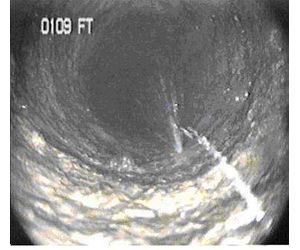
Borehole camera view of a water-bearing
fracture in an uncased well