
Refine by
3d Laser Scanning Articles & Analysis
8 articles found
Super cement producers care about people, products, and profit. 3D scanners, laser, and radar technologies ensure accurate monitoring of product levels. No manufacturer wants to risk a bad batch due to missing materials. That's where sensors come in. Cement manufacturers find non-contact level sensors attractive for several reasons: ...

Every Crop Is Different, and So Is Our Approach No two harvests are ever the same. Soil types, climate, and storage conditions vary, retail standards evolve, and sustainability expectations are rising. For processors, these shifts can mean fluctuating crop size, shape, density, and finish, all of which impact line performance. We design equipment that doesn’t just perform; it adapts. ...

Laser metrology is a subfield of optical metrology that utilizes the unique properties of laser light—coherence, monochromaticity, and low divergence—for precise distance, angle, and dimensional measurements. Instead of physical probing, lasers capture measurements safely and quickly—especially useful for intricate or lightweight items. At its core, laser metrology is about ...
Defect detection in manufacturing refers to the process of identifying imperfections or faults in products during or after production. These defects can range from surface irregularities to structural flaws and dimensional inaccuracies. Detecting these defects early is crucial to ensure that products meet required specifications and quality standards. Advanced systems such as computer vision and ...
3D measurement is a metrology process that uses different types of 3D measurement tools, such as 3D scanners, to collect 3D data from physical objects, such as their shapes, textures, geometries and colours. Scan-to-CAD and inspection software then extracts the 3D measurements from the 3D models for further analysis and processing. What types of companies use 3D measurement? In a nutshell: any ...

What is a Point Cloud? A point cloud is created by scanning an area with a 3D Laser Scanner. This scan is then imported into post-processing software (unless the desired accuracy is obtained in real-time), where errors are removed. ...
Laser-based 3D scanners These scanners cast a laser beam upon the object being scanned so that a camera is able to record where the beam and object intersect. ...
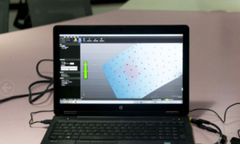
Reverse Engineering Process 1. To obtain 3D date by 3D scanning for objects. 2. By generating point clouds, extracting features, and using reverse engineering software to have date processing for the point clouds. 3. ...