
Algae Sampling Articles & Analysis
12 articles found

Biological Analysis Biological analysis involves the examination of water samples for the presence of microorganisms such as bacteria, viruses, and protozoa. ...
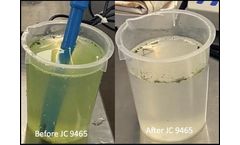
Chlorine is a common product used to deal with algae and biofilm. The Environmental Protection Agency studies have shown chlorine takes over 30 minutes to achieve a 4-log removal. With JC 9465, when we reach an ORP above+700mV, we achieve a 6-log removal in only 10 seconds and remove biofilm while using a significantly lower volume of chemical.In a recent study we have discovered ...

Cuvette – The Cuvette Cell is designed to allow temperature and illumination control of a liquid sample – e.g. for algae studies. Flow-Through Dissolved Species Probe – The Flow-Through Probe is directly mounted on the MS with two ports to allow flow from an external reservoir. ...

The goal of the ClearWaterPMPC (Predicting, Monitoring,Preventing, and Controlling) project was to develop an environmentally friendly technology to prevent growth of blue-green algae in large water reservoirs. The Solution: Installation of Two MPC-Buoy Systems In contrast to currently available ultrasound based algae control systems, the technology developed ...

The field study eliminated the possibility of external pollution and targeted on odorous algal excretion. Odorous water samples were taken at different locations. Headspace solid phase microextraction combined with gas chromatography/mass spectrometry (GC/MS) was employed to identify possible odorants. ...
Some of the cases reported this summer include the harmful algae bloom problem in Lake Erie, the smallest by volume of the Great Lakes. ...
The growth, lipid accumulation and nutrient removal characteristics of an oleaginous microalga Chlorella sp. HQ in two types of secondary effluents (named as X and Q) before/after sterilization were evaluated. The results show that the algal growth rates under sterilization were higher than those under non-sterilization. However, sterilization caused a significant decrease in algal lipid and ...
Sorption of heavy metals by the sea alga Palmaria palmata was investigated in laboratory conditions. The sorption process of the analytes was carried out with constant flow of the solutions through the algae samples. ...

In order to prevent accumulation of debris in the flow-cell and to protect analytical equipment from suspended materials such as sediment and algae, it is common practice for this sample stream to pass through an inline filter/strainer. ...

Semi-quantitative analysis of two algal samples from the Mantaro River taken few kilometres downstream from La Oroya city at Junin, Peru, contained both organic-pollution tolerant and morphologically abnormal diatom associations. The organic pollution is inferred by elevated percentages of Nitzschia palea, Gomphonema parvulum and the Achnanthidium minutissimum complex; the total assemblage ...

The properties of aquatic dissolved organic matter (DOM) isolated by solid phase extraction (SPE) C-18 cartridges, ultrafiltration, and XAD chromatography are compared. Samples taken from the Suwannee River, Georgia, USA and McDonalds Branch in the Pine Barrens, New Jersey, USA were chosen to represent waters where DOM originates from predominantly terrestrially-derived (allochthonous) ...

WET testing exposes laboratory populations of aquatic organisms such as fish, invertebrates, and algae to diluted and undiluted effluent samples under controlled conditions in order to estimate the environmental toxicity of that sample. ...