
Refine by
Borehole Sampling Articles & Analysis
17 articles found

The effect of the pilot SEAR was monitored by sampling and analyzing the ground water from the extraction wells and by estimation of trapped jet-fuel in an oil-water separator as part of the on-site treatment, supplemented by post soil sampling/analyses from boreholes. ...
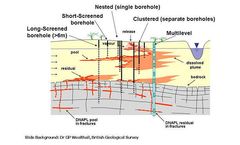
The water quality of a groundwater sample collected from a monitoring borehole or well is critically dependent on two factors: 1) The length of the screened interval in the borehole. 2) The variability in permeability of the adjacent strata. Inflows from more permeable strata or fissures will dominate and bias the sample in the ...

Creating a Borehole Database A series of exploration boreholes were drilled. Samples were taken every five feet and sieved in order to determine the relative percentages of sand, gravel and clay (or other non-sand/gravel material). These samples were restricted to the interval below the base of the soil profile and the top of the ...
The effect of the pilot SEAR was monitored by sampling and analyzing the ground water from the extraction wells and by estimation of trapped jet-fuel in an oil-water separator as part of the on-site treatment, supplemented by post soil sampling/analyses from boreholes. ...

This was done to ascertain the level of organic contamination in the wells located in the study area. The analysis of water samples from boreholes close to the dumpsite was done to constrain the interpretation of electrical resistivity data on the reality of the effect imposed by dumpsite leachate on the hydrolithofacies. ...
The geophysical methods included: 2-dimensional electrical resistivity imaging survey (2-D ERI) and borehole geophysical logging. The 2-D ERI was used to identify locations for the bedrock characterization and injection boreholes. ...
Water samples collected from different sources were analysed for radon concentrations in order to evaluate the health effect associated with radon in water. The radon concentrations were in the range of 3.56–98.57, 0.88–25.49, 0.73–1.35 and 0.24–1.03 Bq.L−1 for borehole, well, packaged and utility water, respectively. Samples from ...
Potable water in the Zululand coastal plain, Sodwana, South Africa can be enhanced by: (i) providing detailed information on the aquifer system using geophysics; (ii) providing information on groundwater quality and its efficient use; (iii) providing low-cost/low technology local drillers with light-weight, manoeuvrable rigs with trained teams for drilling of 6-inch diameter ...

One of the biggest headaches on site is the purge water and the expense of getting rid of it – after it has itself been analysed for radioactivity. Low flow sampling is helping contain and reduce the problems. On site comparison During on-site comparison trials between bailing and low flow, operators from AMEC ran the sampling sequence for comparison in ...
Geotech low flow groundwater analysis equipment has enabled quick and easy access to samples at 2m intervals down a 28m screen in deep boreholes. Elizabeth Guilford of Norfolk County Council hired the low flow kit from Geotech and used it on a Norfolk CC landfill where leachate contamination of groundwater was suspected. Samples taken at 2m ...
Electrical resistivity and the influence of variations in the lake level were investigated using daily water balance measurements, water sampling and geochemical analysis, and well-logging. The geoelectrical resistivity surveys comprised 14 resistivity traverses in the PIW. ...
Quick and easy access in deep wells Geotech low flow groundwater analysis equipment has enabled quick and easy access to samples at 2m intervals down a 28m screen in deep boreholes. Elizabeth Guilford of Norfolk County Council hired the low flow kit from Geotech and used it on a Norfolk CC landfill where leachate contamination of groundwater was suspected. ...
Investigations were conducted on the total and faecal coliform status of streams, hand-dug wells and boreholes highly patronised by communities in the West Akim and Kwaebibirem Districts, Eastern Ghana. Total coliform values obtained range from 60–2,672 cfu, 0–680 cfu and 0–128 cfu for streams, hand-dug wells and boreholes, respectively. Faecal coliform values ...

It is important to understand the conceptual basis and differences in sampling techniques when interpreting sampling results. PDBs may indicate contaminant concentrations higher or lower than those indicated using other sample collection methods. ...

High-resolution boomer profiles from Tai O Bay, Hong Kong SAR, were ground-truthed using ten discontinuously sampled boreholes penetrating bedrock with a maximum length of 82.1 m. The relationship between depth below seabed and seismic profiles was established through the measurement of two borehole compressional-wave velocity profiles. In ...
These monitoring wells are located transverse to and along the plume axis and are screened over 12 m across the water table. Groundwater samples from these boreholes show dissolved phase contamination between 20-30 m depth, with a mixed oxygenate/BTEX plume close to the site and oxygenate-only plume further downgradient. ...
The use of borehole geophysical techniques are also recommended. With this information (together with other site characterization data) and a clear understanding of sampling objectives, then appropriate location, screen length, well diameter, slot size etc. for the monitoring well network can decided. ...