
Refine by
Cow Milking Articles & Analysis
53 articles found

While genetics, weather, and management all play a role, nutrition remains the quiet driver behind calving ease, calf vigor, milk production, and a cow’s ability to breed back on time. At its core, the cow-calf system is built on a remarkable biological partnership. Grazing cattle convert cellulose and fibrous plant material that humans ...

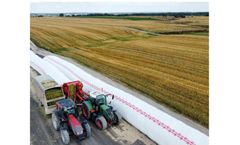
A high-producing dairy cow can require up to 70% of her energy intake just for milk production. In this context, silage provides a high-moisture, energy-rich forage source that supports rumen function and milk production in dairy cows. To support optimal milk production and overall animal health, dry grains ...
To put this into financial terms, for a cow producing 35 pounds of milk per day, a breed-back delay of 30 days results in 1,050 pounds of lost milk. Converting this to hundredweight (cwt), the total is 10.5 cwt (1,050 lbs. ÷ 100). At a milk price of $18 per cwt, the financial loss amounts to $189 per cow ...

More and more consumers are turning to plant-based milk alternatives instead of cow’s milk. As such, the market has seen constant development in recent years. ...

This mild acidity is essential for maintaining the structural integrity of milk proteins and the shelf-life of dairy products. Factors Affecting Milk pH Level Several factors influence the pH level of milk, including: Diet of Cows: The diet of dairy cows significantly affects the pH of milk. ...

Agriculture is an example of this, the area in which the cows are milked needs to be kept clean so there’s no cross contamination between different herds. ...

Similar to optimizing the diets of dairy cows for milk production, we must fine-tune insect diets. Unfortunately, rearing insects is relatively new, so accurate models for predicting optimal diets are yet to be developed. ...
ByBESTMIX

Lactose is the main carbohydrate in cow's milk, and it is also an important source of galactose for breastfeeding infants to ensure brain development. ...

For instance, RFID ear tags used on dairy farms collect vital statistics like feed consumption, milk production and health metrics like temperature and rumination. This gives farmers precise data to make herd improvement decisions and identify any red flags in their herd production. RFID tags are even connected with wireless grain feeding systems, so when a specific ...
ByAGRIVI

Milk fat is one of the most important components of cow's milk. Fat is high in calories and is a carrier and transmitter of vitamins A, D, E and K. ...
An inhibitor persistently decreased enteric methane emission from dairy cows with no negative effect on milk production. PNAS, 112(34), 10663–10668. https://doi.org/10.1073/pnas.1504124112 Oertel, C., Matschullat, J., Zurba, K., Zimmermann, F., & Erasmi, S. (2016). ...
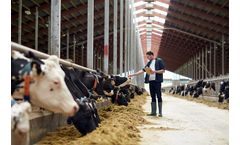
Reducing Methane Production Finding ways to reduce methane production from cows is currently a highly active area of research. Cows, and other ruminant species, produce methane as part of their digestion process. ...
The measurements are usually made during ‘milking’, which takes place between 3 and 6 times per day and are invaluable in the development of methane reducing diets and to identify low emission cow species. ...

This has resulted in farms commonly milking several thousand cows per day. The care and feeding of the animals has produced large waste streams commonly collected and stored in lagoons. ...

America loves farmers, and the data proves it. The Industry of Farming & Agriculture has the highest favorability ratings of all U.S. industries, and farming is regularly ranked one of the most trustworthy professions… so why is there still a major disconnect between food producers and the end consumer? There’s a feeling of “us vs. them” on both sides, and it ...
The difference was extremely significant. He used 30 Holstein cows for the test, and the test group added 50g of cellulase per head per day. The results showed that the total milk production of 15 cows in the experimental group was 2916kg in 68 days; while the total milk production of 15 cows in the control group ...
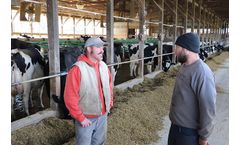
Jerry is the fifth generation of his family to farm at Hardscrabble Farms. In 2000, the Volenecs were milking 130 cows in a double- eight milking parlor. By 2010, they had increased their herd to 199 cows. ...

Buffer consisting mainly of MgO (30 g/day) and sodium bicarbonate (100 g/day) was fed for 8 months to groups of 92 cows with depressed milk fat. Milk fat increased from 3.06% (pre-treatment) to 3.68% at 4 months and 3.71% at 8 months. ...
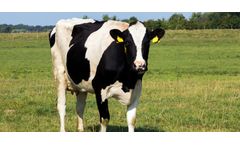
Ruminants can be easily impacted by heat stress. It does not take extremely high temperatures for your animals to experience stresses that can have severe health consequences. In addition to heat, it is also highly important to consider humidity when determining the level of stress your animals might ...

The Impossible Foods commercially offering Plant based meats, our best bets to cutoff Methane from Live stocks. The Honey without bees and Milk Without Cows are most exciting technologies based on Microbiology in the Startup domain. ...