
Refine by
Dioxins Control Articles & Analysis
13 articles found

By converting waste into electricity, waste-to-energy (WTE) plants play a critical role in supporting circular economy and sustainable urban development.However, the incineration process generates complex flue gas streams containing a wide range of pollutants, including:Carbon Monoxide (CO) Nitrogen Oxides (NOx) Sulfur Oxides (SOx) Hydrogen Chloride (HCl) Hydrogen Fluoride (HF) Volatile ...

Several brominated flame retardants (BFRs) have been found to have adverse effect on human health and the environment and classified as persistent organic pollutants (POPs). Mechanochemical destruction is a promising technology for the safe disposal of POPs because it can achieve their complete carbonization by solvent-free high energy ball milling at room temperature, thus preventing ...

In industry, conventional catalyst types typically operate with 5-15% catalyst effectiveness in the SCR of NOx by NH3 and with even lower catalyst utilization in dioxin destruction." Another remarkable feature is low temperature activation. ...
Catalyst-embedded ceramic filters offer a way to remove NOx at lower temperatures, while simultaneously removing PM, SOx, and HCI. The technology also removes organic hazardous air pollutants, THC, dioxins, and mercury. Applications include the Cement NESHAP; Boiler MACT; incinerator CISWI MACT; Hazardous Waste MACT; glass furnaces; ceramics manufacturing, including tracking proppants, kilns, ...
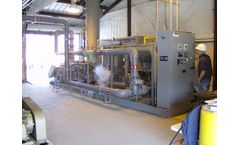
The vapor treatment portion of the project combined ceramic core flameless thermal oxidation (FTO) with acid gas scrubbing, vapor conditioning, and a carbon adsorption polishing step to control potential dioxin emissions. SOLUTION Working with several environmental engineering firms and the US Army Corp of Engineers, Global Technologies supplied a 1,000 SCFM ...
Abstract A demonstration of thermal treatment of dioxin-contaminated soil was completed in Japan, under the sponsorship of the Japan Ministry of the Environment. TerraTherm’s proprietary In-Pile Thermal Desorption process was demonstrated to successfully treat the soil to the required standard of 1,000 picograms of 2,3,7,8-tetrachlorodibenzodioxin (TCDD) toxic equivalents (TEQ) per gram ...
It is a preferred method when using wet scrubbing to collect and control dioxins from combustion sources. As an added benefit, through the use of condensation, the water vapor plume commonly associated with a wet scrubbing system can be effectively eliminated. ...

A questionnaire was used to survey the knowledge and attitude of senior managers toward dioxins at five waste incineration plants and seven coking plants. A field survey was performed to verify dioxin control practices at two of the waste incineration plants and one of the coke plants. All the respondents at the waste incineration plants claimed ...
Methods for assessing human health risks and establishing water quality criteria under the Clean Water Act are based on the assumption that fish accumulation of dioxin is correlated with the dissolved phase of the dioxin in the water column by a water-to-fish predictive factor called a bioconcentration factor. However, dioxin does not remain ...
Emissions of dioxins are mainly from incinerators, domestic and industrial coal combustion, and traffic. ...

The regulations at 40 CFR 63, Subpart LLL are commonly known as PC MACT because the rule establishes the maximum available control technology for hazardous air pollutants (HAPs) from portland cement plants in the United States. ...

The class of compounds made up of the polychlorinated dibenzo-p-dioxins (PCDD) and polychlorinated dibenzofurans (PCDF), often collectively known as dioxins, has received widespread attention and attracted a great deal of research, following the accidental release of the most toxic of these (2,3,7,8 TCDD) at Seveso in 1976. Dioxins, and ...

Untitled Document Summary: During the past several years, there has been growing concern about emission of polychlorinated di-benzo-p-dioxins and polychlorinated di-benzofurans (PCDDs/PCDFs). Dioxins and related compounds are byproducts of combustion formed by recombining other organic constituents and chemical reactions in the combustion effluent-gas stream. ...