
Eu Emissions Trading Articles & Analysis
96 articles found
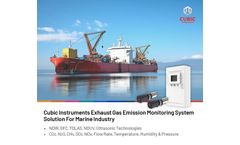
Greenhouse gas (GHG) emissions monitoring requirements are also evolving stricter globally. Building on the Initial IMO Strategy, recent regulations including the EU Emissions Trading System (EUETS) Directive (EU2023/959) and EU MRV Regulation (EU2023/957) will extend GHG emissions monitoring ...

People, the planet and the various economies are vulnerable to climate change, so we need to try to limit this change by working on the factors that cause it, also trying to adapt our world to coexist with what has already changed, limiting the damage as much as possible. A cultural, social and economic change is required and our survival and that of our planet depends on it. Knowledge, ...

Let’s begin: what Carbon Capture, Utilization and Storage is and how it works Carbon Capture, Utilization and Storage (CCUS) consist of a series of technologies to capture carbon (usually as CO2) emitted by various processes, to then either be used or stored in an underground reservoir. Carbon capture can be achieved as part of an industrial process, such as hydrogen, ammonia or ethanol ...

The rate or value of these allowances is known as EUAS (European Emission Allowances). This market is regulated by the EU, which allocates allowances through the EU ETS (EU Emissions Trading Scheme). In the context created by Brexit, a UK Emissions Trading ...

[i] There are also several policy areas where hydrogen will be a key tool even though the H-word is not specifically mentioned. We need new technology The EU wants companies to adapt new technology. “EU industry needs ‘climate and resource frontrunners’ to develop the first commercial applications of breakthrough technologies in key ...

Freezing of Carbon Price Support In view of the fact that the rising price of the EU Emissions Trading System Allowances has pushed up the total carbon price, the Chancellor announced that the current freeze on the Carbon Price Support (CPS) rate will remain at £18/tCO2 for 2020-21. From 2021-22, the Government will look at cutting the ...

Monitoring of emissions is controlled by the Industrial Emissions Directive (IED), which sets out the requirements for emitters to meet. ...
This paper describes the main provisions for Monitoring and Reporting under the European Union’s Emission Trading System (EU ETS). For the largest installations, the ‘Calculation’ approach is based on the measured fuel consumption, fuel carbon content and oxidation factor (completeness of combustion). The latest phase of the ...

What is the Emissions Trading System? Currently, the UK is part of the European Union Emissions Trading System (EU ETS). ...
About this report This 2017 report of the European Environment Agency (EEA) provides an analysis of past, present and future emissions trends under the European Union (EU) Emissions Trading System (ETS), based on the latest data and information available from the European Commission (July 2017 data on verified ...
Please comment on the latest developments around the EU’s Emissions Trading Scheme (ETS) as well as the future of the scheme. Katya: The EU ETS remains the world’s biggest emissions trading market, accounting for over three quarters of international carbon trading. ...
Executive summary This European Environment Agency (EEA) report, Application of the European Union Emissions Trading Directive in 2015, provides an updated overview of the information reported by European Union Member States on the implementation of the EU Emissions Trading System Directive (EU ...
The latest national projections available from EU Member States indicate that by 2020, EU GHG emissions will be well below the 2020 target. Since 2005, emissions from the industrial installations covered under the EU Emissions Trading Scheme (ETS) decreased twice as fast as ...
About this report This 2016 report of the European Environment Agency (EEA) provides an analysis of past, present and future emissions trends under the EU Emissions Trading System (ETS), based on the latest data and information available from the European Commission (i.e. May 2016 data on verified emissions and ...

The problem, Jaccard says, is that carbon pricing is as politically inexpedient as it is economically efficient: “While carbon pricing has become a mantra for economists, environmentalists, academics, celebrities, media pundits and even corporate heads, none of these people needs to get reelected,” he notes. Tough Trading Carbon markets have been a work in progress ...
ByEnsia
Synthesising Member State reporting on the application of the EU ETS Directive The European Union Emissions Trading System (EU ETS) is one of the key climate policy instruments that has been implemented in the European Union (EU) to achieve its objectives of reducing greenhouse gas (GHG) ...

Of several trading scenarios assessed, the authors found that a global emissions trading scheme for both kinds of emissions would be desirable in both environmental and economic terms. ...
The incorporation of aviation into the EU Emissions Trading System (ETS) for greenhouse gases (GHGs) is another such example of market-based instruments described in this report. ...
The most important EU policies were: the Renewable Energy Directive (RED) (5), the Energy Efficiency Directive (EED) (6), the Energy End‑use Efficiency and Energy Services Directive (7), the recast Energy Performance of Buildings Directive (EPBD) (8) and the EU Emissions Trading System (EU ETS) (9). ...
Approximated EU GHG inventory - http://www.eea.europa.eu//publications/approximated-eu-ghg-inventory-2014 European Union Emissions Trading System (DG Climate Action, EEA) The EU emissions trading system (EU ETS) is the cornerstone of the European Union's policy ...