
Geochemical Modeling Articles & Analysis
18 articles found
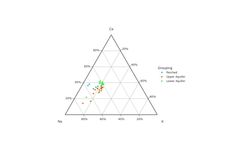
These diagrams help researchers predict the mineralogical changes in response to geological processes. Geochemical Data Visualization: Ternary diagrams provide an efficient way to visualize and interpret complex geochemical data, making identifying trends and anomalies in geological samples easier. Researchers can locate sources of contamination, trace element ...

Project Description The Ernest Henry Mine is a large open pit copper mine with deeper mineralization that was targeted for underground mining. A Feasibility Study (FS) was conducted to evaluate the potential for mining of the underground component by sublevel‐caving methods. The FS required the consideration of groundwater, including an evaluation of the expected inflows to the access ...
Abstract: A geochemical model was developed to predict future water quality of the Cove pit lake in support of site closure and regulatory permitting. ...
To understand and predict the behaviour of volcanoes an increasing number of scientists are combining geological monitoring and geochemical models. By measuring and monitoring the prevalence of gases like CO2, scientists hope to be able to better predict the likelihood of volcanic eruptions. ...

The modelling was performed by using PHREEQC and HCh software that allows application of Pitzer's approach for saline solutions. The modelling was performed for these natural objects for the first time. The model demonstrated that the evaporation-crystallization processes are different for soda and chloride/sulfate brines. ...
The objective of this work was to describe the dynamic and geochemical relationships between surface water and groundwater in the medium-low basin of the Ají stream. The conceptual model was supported by the use of stable 18O/16O and 2H/1H isotopes and it was validated through numerical modeling and 222Rn activity results. ...

This included (i) implementing more robust quality criteria for selecting chronic toxicity data, (ii) the conversion of total to dissolved Pb concentrations using a combination of an empirical equation relating inorganic Pb solubility and geochemical speciation modeling to account for effects of dissolved organic matter, (iii) the use of bioavailability ...
Exposing the organisms to a range of sublethal to supralethal concentrations of the titrated metal was especially helpful in identifying non‐additive interactions. Geochemical processes [e.g., metal‐metal competition for binding to dissolved organic matter and/or the biotic ligand, and possibly supersaturation of exposure waters with the metals in some high‐concentration ...
Analytical techniques were combined with geochemical modelling to study the release mechanisms of pollutants from an abandoned gold mining tailings storage facility near Johannesburg. Inverse modelling of sampled tailings pond water and experimental single extractions using various solutions indicated which combination of naturally occurring ...
In the present study, the fluoride content was chemically analysed and integrated with geochemical model WATEQ4F sampled from Allahabad district, Northern India, with other water quality parameters. ...
Methods for the assessment of the toxic fraction of Al, by chemical analysis and geochemical modelling, have been investigated in selected streams on the Stockton Plateau, where dissolved Al concentrations ranged from 0.034 to 27 mg L−1. Modelling using PHREEQC indicated that between 0.2 and 85% of the dissolved Al was present as ...

AltaRock Energy’s Matt Uddenberg accompanied a group of staff to this year’s Stanford Geothermal Conference, where AltaRock’s Susan Petty and Trenton Cladouhos gave a presentation on the Newberry EGS Demonstration. This was Matt’s first experience with the workshop, so we asked him to share his experience. Why I Went I was fortunate enough to have my first experience ...
Thorough examination of the physico‐chemical characteristics of a Ti processing residue was undertaken including mineralogical, geochemical, and radiochemical characterisation, and an investigation of the environmental toxicity of softwater leachate generated from the residue. ...
The aquifer of Manukan Island of Borneo, Malaysia had been found to be affected by seawater intrusion associated with excessive groundwater exploitation. This research attempted to characterize the chemistry of an impacted zone in the island using factor analysis (FA), cluster analysis (CA) and a hydrochemical model package (PHREEQC). The factor scores were used to plot the spatial map and to ...

Batch leaching tests, qualitative and quantitative x-ray powder diffraction (XRPD) analyses, and geochemical modeling were used to investigate the leaching mechanisms of Cr(VI) from chromite ore processing residue (COPR) samples obtained from an urban area in Hudson County, New Jersey. ...

A regional hydrogeochemical model was developed to evaluate the geochemical evolution of different groundwaters in an alluvial aquifer system in the Interior of Oman. In combination with environmental isotopes the model is able to extract qualitative and quantitative information about recharge, groundwater flow paths and hydraulic connections ...
Monomethylmercury (MMHg) is the compound responsible for the majority of fish consumption advisories in forty eight states in the United States of America. These widespread low level (but toxicologically significant) ecological exposures to MMHg result from microbial methylation of atmospherically deposited inorganic mercury in our national waterbodies. Tributyltin (TBT) is an industrially ...

Even if there are no international standard, there exist a number of normalised test protocols for static and kinetic tests of acid drainage potential, which is a key characteristic with regards to waste originating from sulphidic minerals the behaviour of metallic molecules (originating from mining waste) in the subjacent geologic layers and prediction of their fate using tools such as ...