
Groundwater Sampling Method Articles & Analysis
7 articles found
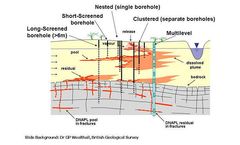
Determining the availability and quality of groundwater has become an issue for an increasing number of businesses and government agencies. Changes in legislation, pressure on aquifer supplies and a heightened awareness of the impact of industrial activity have made groundwater sampling a hot topic. However, collecting a sample from a monitoring borehole that is truly representative of the ...

Regulatory agencies often require three well casing volumes or more be purged prior to collection of groundwater samples for chemical analysis. Costs are high for testing and disposing of potentially hazardous purge water; therefore, efforts must be made to minimize waste-water volume while obtaining representative groundwater ...

This demonstration was initiated to evaluate no-purge technology and indicate the feasibility of using the HydraSleeve no-purge samplers as an alternative groundwater sampling method. On June 18, 2002, eight HydraSleeve point source bailers were deployed in eight groundwater monitoring wells at the former Mather by MWH personnel. ...

US EPA Method 8270D specifies a procedure for the determination of semivolatiles in solid waste and ground water samples. The method specifies that all analyses must be completed within 12 hours of meeting specific MS tune criteria. In this application, the principles of fast GC were applied to analyze a typical 8270 analyte list in under 8.5 minutes. This was achieved by using a 20 m x 0.18 mm ...

Selected ground water sampling and field-filtration methods were evaluated to determine their effects on field parameters and trace metal concentrations in samples collected under several types of field conditions. The study focused on conditions where traditional approaches may produce turbid samples, which often leads to filtration of suspended particles from the sample before laboratory ...

Concentrations of total lead as high as 1,600 g/L were detected in gasoline-contaminated and uncontaminated groundwater at three gasoline-release sites in South Carolina. Total lead concentrations were highest in turbid groundwater samples from gasoline-contaminated and uncontaminated wells, whereas lower turbidity groundwater ...
Many commonly used groundwater sampling techniques and procedures have resulted from methods developed for water supply investigations. These methods have persisted, even though the monitoring goals may have changed from water supply development to contaminant source and plume delineation. Unfortunately, the use of these ...