
Refine by
Heavy Metals Testing Articles & Analysis
19 articles found

Traditional digestion methods are typically time-consuming, inefficient, and complex. The advent of fully automated microwave digestion systems has revolutionized laboratory sample pre-treatment, significantly improving laboratory efficiency and analytical accuracy. I. Highly efficient and rapid digestion capabilities The fully automated microwave digestion system utilizes microwave energy to ...
The latest edition reflects advancements in science and the pharmaceutical industry, including newly added testing requirements for heavy metals and hazardous elements in ten commonly used herbal materials, such as Salvia miltiorrhiza and Angelica sinensis. ...

The detection of heavy metals in medicinal materials is a crucial quality control measure. ...

At the same time, countries around the world have increased their investment in soil metal testing, using advanced technologies such as spectroscopic analysis technology, electrochemical detection technology and biological analysis and the latest research results to study soil heavy metal pollution in order to seek a detection ...

What is Heavy Metals Contaminated Soils Site Characterization? The EPA requires a Toxicity Characteristic Leaching Procedure (TCLP, EPA Method 1311) test to characterize heavy metals contaminated soils and determine how they should be disposed. Soils exhibiting hazardous characteristics, typically leaching ...

Everything from pesticides to heavy metals should be tested for. Potency Testing In potency testing cannabinoids are isolated and their strength and efficacy is evaluated. ...

This was done by checking pH, running quantitative analyses of heavy metals and testing for total coliforms. The effect of ultraviolet (UV) rays on samples positive for coliforms was evaluated. ...

The results show that the concentrations of all OCPs and majority of PAHs were below or close to laboratory detection limits. Concentrations of heavy metals in sludge samples were compared with typical sludge testing results from the USA and UK. Concentrations of heavy metals from the south–eastern Australian ...
Little is known about the hydraulics of sloped compost beds having active free and non-flowing zones, and used for runoff erosion and volume control, and heavy metal removal. Water sorption tests on yard waste compost indicated that water transfer between the two zones would be slow (6 hr for a 0.04 m rise). ...
.% DPS made by dry compression technique, dried and fired at 700°C, 800°C and 900°C. Leaching tests were conducted on fired probes to ascertain their environmental safety. ...

The Isaac Plains Project operates under an Environmental Authority (EA). They needed a field test for heavy metals compliance. The water sources included potable water, mine affected water, natural creek flows, water releases, groundwater and the receiving environment. ...
Whitepaper on DNAzyme heavy metals testing technology. Water pollution is a worldwide problem affecting developing and developed countries alike. ...
The problem of heavy metal pollution arises from several sources. Heavy metals such as uranium can naturally exist in ground water. ...
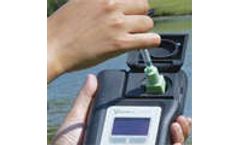
There is a growing need to make the onsite testing of these water supplies easier and more reliable to detect and assess contamination in a timely manner to shorten the harmful health effects of heavy metals in drinking water. ...
Based on the most relevant removal processes (settling, volatilization, sorption, biodegradation, and abiotic degradation), the model allows the dynamic simulation of the MP behaviour in the different compartments of stormwater treatment systems. The model was tested for heavy metals (copper and zinc) and organic substances (benzene and ...
Propylthiol-functionalised mesoporous silica SBA-15 prepared by co-condensation has been tested for heavy metal removal. Adsorption from aqueous solution was examined for Cu(II), Pb(II), Cd(II), and Hg(II). ...

The influence of 10 wt.% mature compost was tested on the heavy metal leachate emissions from a calcium-rich municipal solid waste incineration air pollution control residue (MSWI APC). Apart from elongated columns (500 and 1250 mm), an otherwise norm compliant European percolation test setup was used. More than 99% of the ...
The materials discussed include paper clay and steel slag, and the primary water contamination considered is heavy metal contamination. Paper clay was determined to have the potential for adsorbing heavy metals, and in compacted form could achieve permeability values within the desired range of 10-5 to 10-7 cm/sec required for ...

Abstract Heavy metals at high concentrations are often toxic to living organisms, and their environmental toxicity depends on soil properties. It has long been thought that in clay-rich, low-permeability soils, heavy metals are bound to soil particles, and thus there are only few toxicity risks. This study questioned this ...