
Hydroxyl Generator Articles & Analysis
34 articles found
Foam is one of the most frustrating challenges in wastewater treatment operations. While it may seem like just a cosmetic issue, uncontrolled foam can have serious consequences: it carries solids into the effluent, disrupts secondary clarification, creates odor problems, and even poses safety hazards for operators working around basins and tanks. Traditional methods such as water sprays, ...

Size distribution analysis of microsized water particle mist generated from an odor control technology showed the major- ity of particles to be in the low micron range. The indirect detection and determination of hydroxyl radicals generated by their reaction with benzene to produce phenol was performed through UV-Vis spectrophotometry (UV-Vis) ...

The power behind Genclean’s functionality lies within its advanced oxidation process (AOP). This process generates hydroxyl radicals and reactive oxygen compounds that can oxidize almost all pollutants in water & wastewater at the molecular level. ...

Photocatalyst is a general term for semiconductor materials with photocatalytic function represented by nano-scale titanium dioxide. ...

Residues such as serine, lysine, cysteine and histidine contain nucleophilic active functional groups (hydroxyl, sulfhydryl, amino, etc.), so the protein can act as an excellent nucleophile and can interact with electrophilic active groups to form covalent bonds. ...
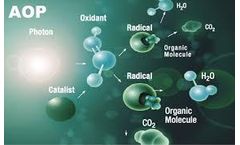
In an overview, advanced oxidation disinfection is a specific treatment process designed to oxidize, disinfect, and remove organic and certain inorganic contaminants from water and wastewater through the generation of hydroxyl radical (OH) and other specific compounds. What is Oxidation Reduction Potential (ORP)? ...
In an overview, AOP disinfection is a specific treatment process designed to oxidize, disinfect, and remove organic and certain inorganic contaminants from water and wastewater through the generation of hydroxyl radical (OH) and other specific ...

Generating Pure Air is an article written by Johnathan McCubbin, Vice President at International Ozone Technologies Group, Inc. ...

All of these patent devices operate from the use of a high-volume, low-pressure regenerative blower arranged in such a way as to maximize the delivery of oxygen to a fluid stream and by the generation of a Venturi from the blower source. The Aerator is designed as an “open” device, that is to say, an unconfined one; the Digester, on the other hand, is designed for an ...

JC 9450 is a new and advanced oxidant that generates reactive oxygen species (ROS) and is NSF Standard 60 approved up to 84 mg/l. ROS are chemically reactive chemical species that contain oxygen (i.e. Ozone, Singlet oxygen, hydroxyl radical ion, peroxides, HOCL, OCL, and superoxide). The main advantage of using JC 9450 is its ability to generate ...

Degradation of 1,1,1-TCA was 49.5% and 95% in the absence and presence of RA. Probe tests confirmed the generation of major hydroxyl radicals (OH•) and minor superoxide species (O2–•), and scavenger tests verified the key role of OH• and less of (O2–•) radicals. ...
It indicated that the decolorization and mineralization of orange II were largely enhanced by the reduction of zero-valent iron in the ball milling process and the oxidation of hydroxyl radicals generated by hydrogen peroxide. It suggested that microwave-assisted ball milling technology has potential application for degradation of azo dye in wastewater. ...
The results showed that quinoline was initially hydroxylated at the C-2 and C-8 positions by hydroxyl radicals (·OH) electro-generated on a β-PbO2 anode, yielding 2(1H)-quinolinone and 8-hydroxyquinoline, then undergoing ring cleavage to form pyridine, nicotinic acid, pyridine-2-carboxaldehyde and acetophenone, which were ultimately converted to ...
http://www.randrmagonline.com/articles/86169-what-you-need-to-know-about-hydroxyl-generators The main benefit of using a true hydroxyl generator is that they are safe to use in occupied areas for deodorization purposes. ...
Fluorescence spectrum experiment confirmed that hydroxyl radicals could be generated in the system combined nZVI with ultrasonic irradiation, and as a result, hydroxyl radicals would contribute to the decolorization process of MO. ...
The presence of ACC increased the concentration of hydroxyl radicals generated in the FeSO4 + H2O2 system. The presence of ACC during Fenton oxidation largely increased TOC and GA removal, attributable to the adsorption of GA and its degradation products and the increased generation of OH• radicals that mineralize them. In the ...
As an alternative, photocatalysis and photoelectrochemical treatment has a high disinfection potential in drinking water by using solid catalysts, such as titanium dioxide. Highly reactive hydroxyl radical generated during the process serves as the main oxidant, capable of inactivating a wide range of microorganisms. ...
People involved in water treatment speak generally of an "algae" problem. In fact, it is more accurate to use the term "plankton". ...
However, under alkaline environment, ozone generates a hydroxyl radical (•OH) that exhibits strong oxidative potential. ...