
Refine by
Laboratory Solvent Articles & Analysis
14 articles found
Technology selection depends on: VOC concentration Airflow volume Gas composition Temperature and humidity Safety requirements Energy consumption and operating cost Recommended Selection Logic High Concentration + Low Airflow Suitable technologies: RTO TO CO RCO Low Concentration + High Airflow Suitable technologies: Zeolite rotor concentration + RTO Adsorption concentration ...

Differences often arise from variations in reagent concentration, extraction methods, solvent purity, and laboratory standards. Such factors can influence sensitivity and specificity, so it is advisable to optimize protocols for the plant species and laboratory conditions in use. ...

Laboratory PP acid tank, because laboratory PP acid tank is made of PP anti-corrosion plastic material, so laboratory PP acid tank is also called PP acid tank, pvc acid tank, plastic anti-corrosion acid tank. ...

EPA Method 1664, “if the emulsion is greater than one-third the volume of the solvent layer, the laboratory must employ emulsion-breaking techniques to complete the phase ...

“After applying the most efficient Syncore® parameters for concentrations and solvent exchanges, you will be thinking of ways for your lab to afford the next ...
ByBUCHI
Infrared measurement also requires 90 percent less solvent than EPA Method 1664B. “The savings in manpower and solvent have more than paid for the infrared instrument in the two years that we have been using it,” the Lab Manager concluded. ...

Some can be done with direct reading instruments, others may require obtaining a sample for laboratory analysis. Natural Gas The highest priority is if it smells like natural gas. ...

It should also be noted, that US EPA 5035 includes the handling of soils which exceed normal VOC concentration levels (greater than 200 ppb).1 Introduction US EPA Method 5035 allows for two soil sample collection options that can be used in accordance with US EPA Method 8260C: “The first option is to collect an appropriate sample volume in a pre-weighed vial with a septum-sealed screw-cap ...

Especially when particular kinds of waste are involved, from solids to liquids like infectious sewage water and fluids coming from laboratories. As stated in the book “Greening Health Care: How Hospitals Can Heal the Planet”, published by the Oxford University Press: «While hospitals have perhaps the most complex waste streams of any industry - plastic, chemicals, paper, food, ...

The EX-1000 installed on Benchamas processing platform has been performing well, but the parameter should be adjusted to get better agreement with the laboratory result. Advanced Sensor’s OIW monitors reduce lab technician time and solvent use/exposure. ...
Customer name Tod Kopyscinski Company / Institution Con-Test® Analytical Laboratories, USA Product lines Parallel Evaporation Industries Environmental Customer: Con-Test Analytical Laboratories, USA Con-Test Analytical Laboratory provides environmental and hygiene analytical services with the capability of analyzing nearly all water, ...
ByBUCHI
Certain types of samples, such as those containing detergent, may form emulsions when doing an oil in water extraction into a solvent. The boundary between the solvent and the sample will have an emulsion layer that lias a cloudy or milky appearance as shown in tlris photo. ...
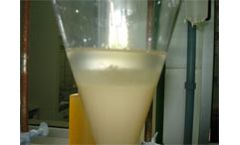
EPA Method 1664, “if the emulsion is greater than one-third the volume of the solvent layer, the laboratory must employ emulsion-breaking techniques to complete the phase separation”. ...
The technology, however, might have potential for treating these soils if a few lingering technical issues can be resolved. In 1982, the Army conducted laboratory-scale solvent extraction on explosives-contaminated lagoon samples from a number of sites. ...