
Refine by
Local Exhaust Ventilation Articles & Analysis
45 articles found

Introduction Printed Circuit Board (PCB) assembly is one of the most common applications where soldering fumes are generated continuously throughout the production process. Whether through manual soldering, selective soldering, wave soldering, or rework operations, flux vapors and solder smoke are released directly into the operator's breathing zone. Without proper ventilation, these ...
Introduction A well-designed soldering workstation is essential for maintaining operator safety, product quality, and workplace productivity in electronics manufacturing environments. While factors such as lighting, ergonomics, and tool placement often receive significant attention, ventilation is frequently overlooked despite being one of the most important elements of workstation design. ...
Introduction Modern electronics manufacturing environments require clean, safe, and flexible workstations for soldering operations. Whether in PCB assembly, repair stations, laboratories, or electronics production lines, soldering processes generate fumes containing flux vapors, fine particulate matter, and volatile organic compounds (VOCs). Without proper ventilation, these contaminants can ...
Introduction Soldering operations in electronics manufacturing generate more than just visible smoke. When flux compounds are heated during soldering, they release volatile organic compounds (VOCs), resin vapors, odors, and fine airborne contaminants that can accumulate rapidly in enclosed workspaces. While particulate filters capture smoke particles, gaseous contaminants require a different ...
Introduction Soldering operations in electronics manufacturing generate fumes that contain flux vapors, fine particulate matter, and volatile organic compounds (VOCs). These fumes are released directly into the operator’s breathing zone and can quickly accumulate in enclosed workspaces if not controlled effectively. ...
Over time, exposure to these contaminants can affect operator health, indoor air quality, and overall workplace safety. Understanding soldering fumes health risks is essential for designing safer electronics production environments and implementing effective control measures. Proper flux fumes extraction and engineered electronics soldering ventilation systems are critical for minimizing ...
Introduction Electronics manufacturing processes such as manual soldering, wave soldering, and rework operations generate fumes containing flux vapors, fine particulate matter, and volatile organic compounds (VOCs). Although soldering fumes may appear less intense than welding fumes, prolonged exposure in enclosed workspaces can significantly affect indoor air quality and operator health. ...
Introduction Welding processes generate a complex mix of airborne contaminants, including metal fumes, gases, and ultrafine particles. These contaminants are produced directly at the welding arc an dean quickly disperse into the surrounding workspace if not effectively controlled. In industrial environments where welding is performed continuously, this leads to poor air quality, reduced ...
Introduction Welding operations are a critical part of industrial fabrication, but they generate hazardous fumes composed of fine metal particulates and gases. These fumes, if not effectively controlled, disperse into the work environment and expose workers to harmful contaminants. In fabrication shops where multiple welding stations operate simultaneously, this issue becomes significantly more ...

Traditional emissions testing and stack measurements offer limited real-time visibility and may not capture short-term fluctuations or localized deposition on the shop floor.Real-time monitoring and high-resolution air quality data enable visibility into emission patterns, supporting accurate, targeted control options, enhanced ventilation, and proactive ...
These enclosures are not mere boxes; they are engineered with sealed access points, acoustically treated ventilation, and vibration isolation mounts that prevent structure-borne noise transmission. ...
Why Indoor Air Quality Matters at Work Indoor air quality has a direct impact on worker comfort, health, and performance. In industrial environments, welding, soldering, machining, and grinding release fumes, dust, and mist into the workspace. If these pollutants are not controlled, they accumulate and affect employees throughout the day. Poor indoor air quality not only increases health risks ...
Why Multi-Station Areas Need Strong Fume Control Modern workshops often run several welding, soldering, or machining stations side by side. While this improves productivity, it also increases the concentration of fumes in one shared space. If the fumes are not controlled properly, they spread across stations and affect every worker in the area. Multi-station layouts make fume extraction systems ...
Why Indoor Pollution Deserves More Attention Most people associate air pollution with outdoor sources such as traffic, factories, and construction. However, indoor air pollution can be far more harmful, especially in industrial environments where workers spend long hours near fumes, dust, and mist. Indoor pollutants do not disperse as easily as outdoor pollutants. They remain trapped inside the ...
Understanding Welding Safety Requirements Welding is a core process in manufacturing, fabrication, automotive work, and construction. It also comes with risks such as harmful fumes, heat, sparks, and exposure to metal vapors. To reduce these risks, Indian industries must follow specific safety regulations issued by bodies like the Directorate General, Factory Advice Service and Labour Institutes ...
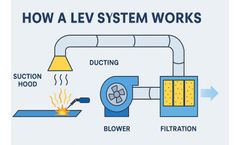
What is a LEV System? A local exhaust ventilation system is one that is designed to capture and remove airborne contaminants at the generation point. ...

For example, welders, who, despite now using supposedly less dangerous materials and working in spaces where local exhaust ventilation (LEV) is employed, seem to be vulnerable to a far wider range of illnesses than previously thought. ...

Windbreaks and Barriers: Installing physical barriers around open yards or stockpiles helps reduce wind-blown dust, especially in exposed environments Local Exhaust Ventilation (LEV): LEV systems capture airborne dust at the point of release, using hoods and ductwork to direct it to filters or dust collectors. ...

Two commonly employed approaches are general dilution ventilation and local exhaust ventilation, which can be utilized individually or in combination to optimize airflow management. ...

Chemical Exposure Control: Minimize worker exposure to hazardous chemicals generated during the pyrolysis process by implementing engineering controls such as local exhaust ventilation and enclosure systems. Provide appropriate PPE, such as respirators, gloves, and protective clothing, to workers handling feedstock, intermediates, and products to ...