
Refine by
Particulate Emissions Control Articles & Analysis
23 articles found
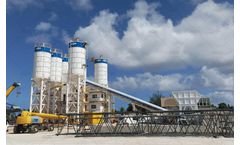
Concrete production, historically one of the sector's most resource-intensive and emission-prone operations, is under intense scrutiny from regulators, clients, and communities alike. ...
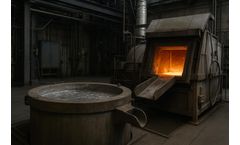
Benefits include improved process consistency, safety, and labor cost reductions. Emission Control Integration Emission streams from lead refining require integrated control. Key targets include: Particulate emissions: lead fume and dust; controlled by ventilation with baghouse ...

Introduction Welding operations across manufacturing industries generate airborne contaminants in the form of metal fumes, gases, and ultrafine particulate matter These emissions, if not properly controlled, can accumulate within the workspace and expose workers to hazardous substances. ...
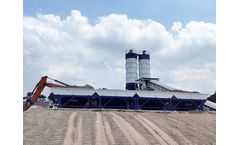
Analyzing this shift reveals that sustainability is intrinsically linked to performance. A plant that effectively controls dust emissions, for instance, also reduces material loss and improves the working environment for its personnel. ...
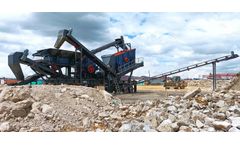
Taking these measures not only reduces environmental impact but also helps operators meet regulatory expectations and community standards—while keeping operations smooth and penalties at bay.Air Quality: Dust Suppression and Emission Controls Mitigating airborne particulate matter Concrete crushing emits significant dust—fine, respirable ...

These crushers not only optimize material recycling but also reduce energy consumption and carbon emissions, making them an ideal green solution for modern construction sites.The Environmental Challenge of Construction Waste The Growing Issue of Demolition Debris The construction industry generates an overwhelming volume of waste, with concrete and asphalt constituting the ...

Abstract Wet electrostatic precipitation technology can be used to control acid mists, sub-micron particulate, mercury, metals and dioxins/furans as the final polishing device within a multi-pollutant air pollution control system. ...

Industry Sector: Waste to Energy Material: Animal Waste (Combustion by product) Dust Loadings: Less than 10 mg/m3 Installation: 8 Individual Baghouse compartment outlets APPLICATION Waste to Energy Plants operate under strict particulate emission control limits, which typically requires the installation of multi-compartment baghouses. ...
ByENVEA
Introduction ENVEA have been at the forefront of environmental monitoring and process control over four decades and with the emergence of the Industrial Internet of Things (Industry 4.0) ENVEA are again providing innovative solutions which harness the potential of this new industrial era. In this series of articles, we will be exploring the relationship between industrialisation and ...
ByENVEA
Introduction ENVEA have been at the forefront of environmental monitoring and process control over four decades and with the emergence of the Industrial Internet of Things (Industry 4.0), ENVEA are again providing innovative solutions which harness the potential of this new industrial era. In this series of articles, we will be exploring the relationship between industrialisation and ...
ByENVEA
Introduction ENVEA have been at the forefront of environmental monitoring and process control over four decades and with the emergence of the Industrial Internet of Things (Industry 4.0), ENVEA are again providing innovative solutions which harness the potential of this new industrial era. In this series of articles, we will be exploring the relationship between industrialisation and ...
ByENVEA

OVERVIEW A major automotive component supplier needed to control the emissions from its paint spray process. The plant emissions had characteristics common to many paint spray plants: high air flow, low volatile organic compound (VOC) concentration and particulate. The company needed an emission ...

CC-88™ allows operations at lower excess air, reducing plume opacity and reducing NOx. CC-88™ helps keep PM (particulate matters) emissions under ...
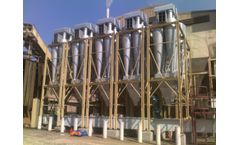
(ACS) designed and installed, on a turnkey basis, a hurricane system and a Mechanical ReCyclone (ReCyclone MH) for Particulate Matter (PM) emission control of the flue gases from two biomass boilers. ...

FOREWORD Advanced Cyclone Systems, S. A. (ACS) designed a settling chamber, followed by a Hurricane system with the double purpose of dust recovery and Particulate Matter (PM) emission reduction, from a sawdust rotary dryer in an industrial wood pellets production plant with 2 ton/h capacity (VIMASOL). High quality pellets are manufactured from sawdust coming from nearby sawmilling plants ...
The development of new optimized dedusting systems has particular and increasing relevance for atmospheric particulate emission control. Indeed, traditional "particulatetraps" present several disadvantages that foster the search for alternative solutions. Industrial cyclones are, for their robust construction, absence of moving parts and general ...

A myriad of filter media are utilized today for separation of particulate matter in industrial gas filtration applications. These media range from single use (deposable) to semi-permanent media and include fiber, fabric, ceramic, membrane, metal mesh, and sintered metal media. ...
Problem A major automotive component supplier needed to control the emissions from its paint spray process. The plant emissions had characteristics common to many paint spray plants: high air flow, low volatile organic compound (VOC) concentration and particulate. The company needed an emission ...

Cloud chamber technology uses electrically charged water droplets to attract fine particles and remove them from exhaust streams. At the Saint-Gobain Advanced Ceramics Boron Nitride (formerly Carborundum) plant in Amherst, N.Y., the technology has exceeded required performance criteria and helped a plant with an air pollution control problem remain a part of the local industrial ...

The installation of a gas reflux draft control system, or GRDCS, provided constant control of the oxidizer draft without operator intervention to within 0.1 inches w.c. ...