
Refine by
Recycling Sorting System Articles & Analysis
40 articles found
Plastic pollution is one of the most urgent environmental challenges of the 21st century. With global plastic production reaching hundreds of millions of tons annually, traditional disposal methods—such as landfilling and incineration—are no longer sustainable. As governments tighten waste regulations and consumers call for greener solutions, advanced plastic recycling technologies ...

Automated waste sorting systems are revolutionizing recycling facilities worldwide, achieving up to 85% greater accuracy than manual sorting methods. PICVISA, a leader in machine vision and AI-based recycling solutions based in Barcelona, Spain, offers cutting-edge automated waste sorting ...
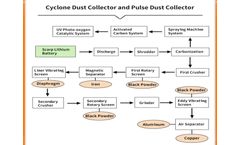
High-voltage (HV) batteries are recyclable. Primarily composed of lithium-ion cells, these batteries are typically utilized in applications such as electric vehicles and energy storage systems, characterized by their high capacity and high voltage. ...
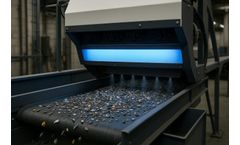
For detailed conveyor integration specifications, refer to GME’s battery recycling conveyor belt systems guidance.Data Collection and AnalyticsEach sorting event generates a process intelligence dataset, including material composition, throughput, purity estimates, and ejection frequencies. ...
PICVISA provides the plastic recycling industry with solutions that are a benchmark in efficiency and quality assurance of the final product: the ECOPACK and ECOFLAKE optical sorting systems. ...
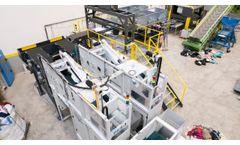
The focus here is on reuse and recycling. PICVISA, textile sorting, AI © PICVISA PICVISA, a specialist in AI-based optical sorting technologies for the reuse and recycling of materials, and GIRBAU, a global leader in industrial laundry and automation solutions, have announced a strategic collaboration to advance the full ...
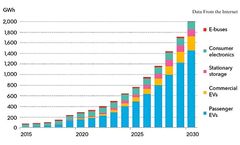
We offer: Advanced Technology: Proprietary battery recycling processes (crushing and sorting system) maximize material recovery rates, yielding high-purity copper, aluminum, and black mass. Environmentally Friendly Process: A fully enclosed lithium-ion battery recycling system, equipped with exhaust gas and dust ...
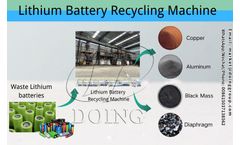
The current lithium battery recycling technology is diverse, including mechanical sorting, hydrometallurgy, heat treatment and other methods. ...
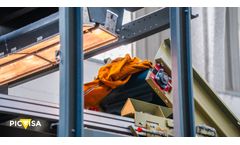
Understanding Material Recovery Facilities (MRF) and why they matter Fortunately, before throwing anything away, our minds switch to “recycling mode” to decide where to dispose of it: the bin for organic waste, the one we’ve chosen for metal and plastic, the spot where we leave bottles-and perhaps some broken glass-the bottle where we store used cooking oil, the paper bag reserved for used papers ...

Hence the importance of promoting textile recycling, a process that involves several stages:Collection and sorting of used clothing. ...
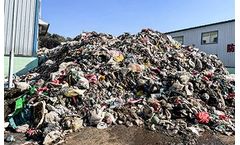
After proper classification, most non-recyclable municipal solid waste undergoes non-hazardous treatment through methods such as landfilling and incineration. ...

Thanks to an efficient collection and sorting system, Germany recovers about 75% of its textile waste for reuse and recycling, according to the German Federation of the Textile and Fashion Industry. ...
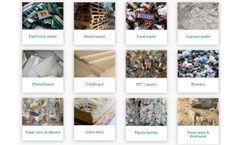
Why is energy efficiency important in recycling operations? Energy efficiency stands at the forefront of optimizing recycling operations, serving a pivotal role in cutting down operational expenses, bolstering environmental sustainability, and significantly reducing the carbon footprint associated with recycling activities. The utilization of efficient machinery is paramount, as it not only ...
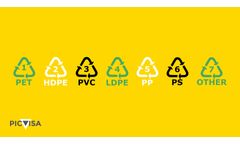
Plastics take a long time to degrade, which is why recycling them is so important. The advantage is that their reuse offers great potential—so much so that research is already underway to convert them into green hydrogen. According to La Vanguardia, Dr. Manish Shetty, a professor of engineering, is leading a research team at the University of Texas A&M to study how to break down ...

Waste medical blister packaging, as a common waste in life, are generally made of aluminum and plastic, which are recyclable materials, as we all know. Medical blister packaging recycling machine can sort out the aluminum and plastic in the waste medical blister packaging, thus helping us obtain considerable profits. Well, how much profit can the medical blister packaging recycling machine help ...
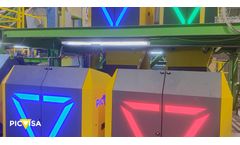
Citizens have finally become aware that good waste management requires separation at source and proper recycling.However, it was not until the 80’s that recycling began to gain importance in our country. In fact, it was then that glass companies installed the first glass recycling containers in San Sebastian, Madrid and Barcelona. ...

If a plastic product ends up in a landfill and is not recycled, the possibility of obtaining new resources is eliminated. And if they are left in nature, the environmental impact is particularly negative, as they degrade very slowly, their basic elements remaining in the environment, fragmented in the long term into micro- or even nano-sized particles. ...
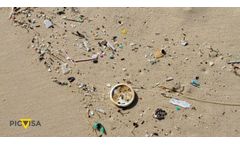
Waste on beaches: A failure of civic responsibility and recycling management Spain holds a remarkable record of 30 years with beaches awarded the Blue Flag, a distinction from theEuropean Environmental Education Foundation (EEF). As of 2024, Spain boasts 638 beaches flying these flags, an increase of 11 from the previous year, securing its position as the global leader in environmental ...
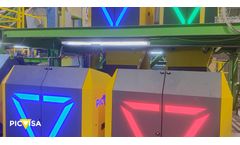
Citizens have finally become aware that good waste management requires separation at source and proper recycling. However, it was not until the 80’s that recycling began to gain importance in our country. ...

Here are seven key points exploring the various technologies driving e-waste recycling in the country: Automated Sorting Systems: Advanced automated sorting systems are employed to segregate different types of electronic waste efficiently. These systems use sensors, conveyor belts, and robotic ...
ByEcoverva