
Refine by
Soil Compaction Testing Articles & Analysis
6 articles found
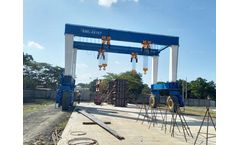
To mitigate this:Use high-quality, dense asphalt mixes.Ensure adequate thickness (minimum 250–300 mm for heavy RTGs).Incorporate proper base layers with compacted granular material.c. Soil and Compacted GravelFor temporary or less intensive operations, compacted gravel or engineered soil bases may suffice. ...

The development of a standard effort compaction test method for determining compaction characteristics of soil-rock mixtures having maximum particle sizes up to 51 or 76 mm (2 or 3 in.) is described. The method is based on results of a testing program to develop testing procedures for 305 and ...
The purpose of this proposed standard is to standardize a test method for determining standard effort compaction characteristics of soil-rock mixtures containing particles larger than the 3/4-in. (19.0-mm) sieve and finer than the 3-in. (76.2-mm) sieve. ...
A relatively compact soil testing system that is capable of performing monotonic/cyclic triaxial and torsional simple shear tests has been developed. ...
This paper examines the possible factors that contribute to the dispersive behavior of compacted nonswelling clays and proposes the use of a synthetic organic stabilizing agent to reduce the dispersive tendency of such soils. ...
Field hydraulic conductivity tests are required to determine the in situ hydraulic conductivity of compacted clay soils used in the liners for hazardous waste management facilities. The test must be capable of measuring hydraulic conductivities of 1 × 10⁻⁹ m/s or less, and the values obtained must be representative of the overall ...