
Refine by
Subsurface Modeling Articles & Analysis
26 articles found
As a result: Engineers need environmental context to make informed design decisions Environmental teams need subsurface and groundwater data to model risk pathways Compliance teams need traceable, auditable data flows Managers need integrated reporting instead of fragmented spreadsheets This shift is accelerating adoption of modern EDMS alternatives that move ...

Los Angeles County Flood Control District Overview HEC-HMS model of 110 sq. mi. urban watersheds Development of custom LiDAR processing tools "What-if" mitigation scenarios analyzed Applied Software WMS (HEC-HMS, MODRAT, XPSWMM) SMS (TUFLOW) Problem A study conducted by Los Angeles County Flood Control District determined that some of the levees along Compton Creek and Dominguez ...

ALDOT also implemented ProjectWise as the collaborative platform to seamlessly share and exchange models and information. The organization imported the 3D models into MicroStation for design verification and clash detection and produced animated visual renderings with LumenRT to communicate project impact to stakeholders and the public. ...

This causes the electric current to gather in and flow through any subsurface water bearing features, generating a magnetic field that is measured in a grid-like pattern at the earth’s surface using a highly sensitive magnetometer. This magnetic field data is then used to generate maps and 3D models of the subsurface groundwater conditions, ...

The xpswmm program was used to simulate the routing of storm flows into Best Management Practices (BMP) before discharging to Lake Tahoe during several runoff events. The model was run in hydrology and hydraulics modes and involves surface and subsurface conveyance features and storage facilities. ...
ByInnovyze

That’s why oil companies employ geologists to model the subsurface. The same care is required when injecting CO2, says German geologist Stephan Matthai, who leads the reservoir engineering team. ...
ByEnsia

In this paper, a recently developed stochastic model using transients for detecting partial blockages in water pipelines is tested and numerical and experimental case studies are presented. The model is a stochastic successive linear estimator previously used in groundwater hydrology for detecting the heterogeneity pattern of the subsurface. The ...
Rice paddy water management was integrated into a distributed three-dimensional surface and subsurface coupling hydrological model of the Sakuragawa River watershed. ...
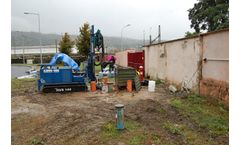
Based on this work a Conceptual Site Model (CSM) has been developed detailing the subsurface conditions followed by a preliminary risk analysis. ...

This TD-PO model should be applied for detection and location of objects hidden in opaque media by subsurface TD radar system. The proposed approach allows considering of basic physical principles, governing electromagnetic radiation and scattering and reception, to form electromagnetic image of subsurface region by simulation of radar returns ...
A subsurface radar technique is used for a microwave non-invasive probing in opaque regions in soils, rocks, fresh water, brick, concrete etc. There is an inherent complexity of a subsurface radar survey some. Unavoidable features of a radar functioning, numerous wave propagation and scattering events complicate seriously a radar data processing and an interpretation [3]. Such electromagnetic ...

The results of the first phase added some valuable structural (3D P-wave velocity model) and lithological (3D Vp/Vs model) information concerning the subsurface conditions prevailing the area of interest. ...

The model was constructed by coupling TOPMODEL and MODFLOW without writing new code for the integrated model. ...
“We did a simple groundwater model to try and predict how much water was going to come into the quarry. ...
Beyond that, the data pulled needed to be able to be plugged into earth models for the engineers and scientists, but also into presentation formats for executives. ...
Passive Seismic Tomography Project Phase II Project Area: approximately 2000km2 Seismic Network: 76 stations Recording Period: 9 months Number of Seismic Events located/used: 276/263 The scope of this project, which followed a successful Phase I Passive Seismic Tomography survey in the same area, was to provide accurate and reliable 3D P-wave velocity and Vp/Vs models, ...
Passive Seismic Tomography Project Phase II Project Area: approximately 400km2 Seismic Network: 70 stations Recording Period: 11 months Number of Seismic Events located/used: 1200/1100 The scope of this project, which followed a successful Phase I Passive Seismic Tomography survey, was to provide accurate and reliable 3D P-wave velocity and Vp/Vs models, adequate for ...
The Operator Splitting scheme is a favourite and approved method for simulating multi component reactive transport systems. This scheme can easily be applied to the situation where large time scale differences between the transport and reaction steps exist. In the current work, different schemes of coupling such as Cellular Automaton and Gillespie Algorithm, and Finite Difference & Ordinary ...
Empirically based lumped hydrologic models have an extensive track record of use for various engineering applications. ...
There is a need for a simplified computer-based design tool for subsurface flow constructed wetlands (CWs) which is based on process-based numerical models. ...