
Refine by
Ultrafiltration Process Articles & Analysis
74 articles found
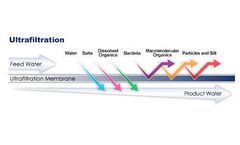
One facet of technological advancement is attempting to mitigate the more glaring issues that consistently crop up due to the nature of a system process. Of course, even with decades of improvement nothing is infallible. In this article, we will discuss the common issues that can occur using UF filtration systems. Ultrafiltration is a pressure driven membrane ...
As technology has advanced and novel stains of specific bacterial properties have become available (Hammes 2010), flow cytometry has been applied to numerous industrial microbiological processes (Diaz 2010). Notably, flow cytometry was introduced in the drinking water industry a decade ago and is establishing itself as a standard microbiological tool to enumerate the bacteria ...

A more efficient way to prepare samples for IC analysis is by using Metrohm Inline Sample Preparation (MISP) techniques to automate the process. Either Metrohm Inline Ultrafiltration (UF) or Inline Dialysis can be used to safeguard the IC system from harmful matrix components while simultaneously reducing manual labor and increasing sample ...
ByB&W Tek

Many of the waste products generated during dairy production, such as whey, buttermilk, wastewater from cheese processing, and ultrafiltration permeates, are costly to treat and discard. ...
Ultrafiltration with semipermeable membranes can play an important role in water purification because of its compactness and efficiency Ultrafiltration (UF) is a water purification process in which water is forced through a semipermeable membrane. ...

Application: pesticide wastewater Scale: 7500 tons / day Process: Jiarong tube ultrafiltration membrane INTRODUCTION Project Introduction: Lier Chemical's 7,500 tons / day pesticide wastewater treatment project is a very large MBR tubular membrane project. ...

Since January 2005, the aerobic membrane biology Biomar® OMB with nitrification and denitrification stage has been in operation as intended. A special ultrafiltration plant is integrated in the biological process. The process is designed to keep the volume of water in the plant low, which is important when space is tight, as is the case with ...
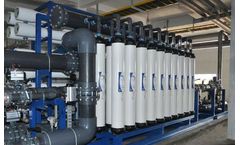
In this article, I will talk about ultrafiltration uses for the treatment of dairy and beverage product wastewater streams. ...
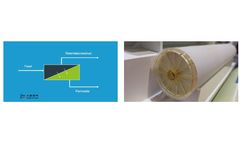
When treating water containing highly suspended solids, primary (screening, flotation and filtration) and some secondary treatments are often used as a pretreatment stage to incorporate ultrafiltration into the process. When water recovery is simple, very little processing is often required. ...
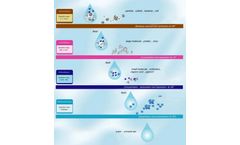
Microfiltration (commonly abbreviated to MF) is a type of physical filtration process where a contaminated fluid is passed through a special pore-sized membrane to separate microorganisms and suspended particles from process liquid. MF membrane is commonly used in conjunction with various other separation processes such as ...
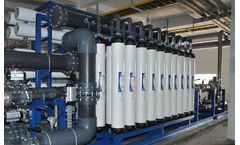
In one of the previous articles on ultrafiltration, we had talked about some of the common problems associated with UF water purification. ...
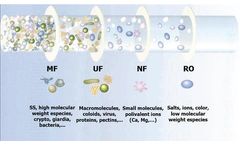
There are many potential applications for such technology, but in particular, is its usefulness in water & wastewater treatment. Micro and ultrafiltration purification are two such membrane technologies.They are very similar filtration/separation processes with a difference that makes each ideal for their own particular applications. ...
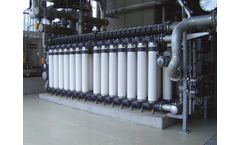
There are a few options to remove them, but some others require the introduction of chemicals into the wastewater. Ultrafiltration can be one tool in a chemical-free treatment process for this particular application.Textile wastewaterTextile facilities use large volumes of water for various cleaning and dyeing processes and so they also create ...

What is it? Ultrafiltration treatment is a form of membrane filtration similar to reverse osmosis, separating solid particles from the liquid influent source. This process lies between microfiltration and nanofiltration in terms of particle capture size removal. It has applications as a prefilter for other treatment processes or as a tertiary ...
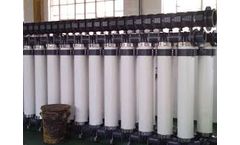
What is ultrafiltration, and how does this process work? What is it ? Ultrafiltration is a form of membrane filtration similar to reverse osmosis, separating solid particles from the liquid influent source. ...

Now, the list of membrane processes used in water treatment has lengthened to include: Forward osmosis Reverse osmosis Microfiltration Ultrafiltration Nanofiltration Different processes require different types of membrane, broadly speaking, either functioning as a sieve or separating water from impurities on a molecular level. ...
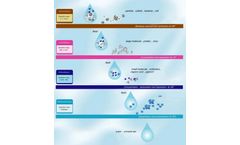
Microfiltration (commonly abbreviated to MF) is a type of physical filtration process where a contaminated fluid is passed through a special pore-sized membrane to separate microorganisms and suspended particles from process liquid. MF membrane is commonly used in conjunction with various other separation processes such as ...
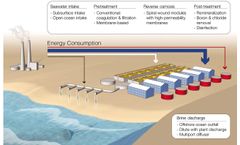
Pretreatment Pretreatment is crucial for the operation and maintenance of the reverse osmosis system process. Particulate matter that could foul the membrane needs to be removed. ...
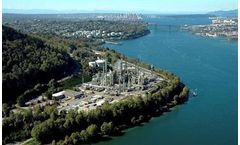
Each of these fractions will be sent along to separate process to be turned into the different oil products. Therefore, remediation of refinery wastewater from these different processes can be quite complex. ...
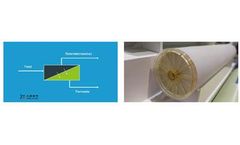
When treating water containing highly suspended solids, primary (screening, flotation and filtration) and some secondary treatments are often used as a pretreatment stage to incorporate ultrafiltration into the process. When water recovery is simple, very little processing is often required. ...