
Variable Air System Articles & Analysis
9 articles found

Energy-Efficient Fume Hoods in Green Laboratories Variable Air Volume (VAV) Systems: Tailoring Airflow to Laboratory Needs One notable energy-efficient option for fume hoods is the integration of Variable Air Volume (VAV) systems. Traditional fume hoods rely on constant air ...

Strategies for Effective Airflow Management HVAC System Design A well-designed heating, ventilation, and air conditioning (HVAC) system is paramount in ensuring optimal airflow management within laboratory environments. ...

They concluded that future biology-based purification systems would be more promising than artificial solutions, especially the variability in air pollutant concentrations. These systems would need to assure humidity control of purified air as well as incorporate CO2 removal. ...
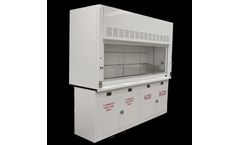
They directly measure the velocity of the air coming into a fume hood, ensuring that the hood has adequate containment and ventilation. ...

Ducted fume hoods remove the air from the laboratory and disperse it into the atmosphere outside. While many ducted hoods employ constant air volume (CAV) systems, variable air volume (VAV) systems are a new generation of hoods that reduce energy costs. VAV systems reduce the ...

If the fume hood is on a constant air volume (CAV) system, then you can use either a digital or analog airflow monitor provided by the hood manufacturer. However, if the hood is on a variable air volume (VAV) system, then the airflow monitor needs to come from the VAV supplier so that it can be properly ...

One of the most important challenges in nonlinear, multi–input and multi–output (MIMO) and time variant systems is designing a controller with acceptable performance. This paper focuses on design a new adaptive fuzzy PID decoupling controller, applied in the VAV air–conditioning system. ...
A well-structured management system must be based on efficient tools that integrate diverse sets of information - emissions, traffic, meteorological variables and air quality data. Ideally, such a system should include appropriate modelling tools that could be used to perform spatial interpolation and air quality ...

Abstract Variable-volume exhaust systems are a common feature of laboratory ventilation designs. By reducing exhaust airflow in proportion to the actual need, the system uses less energy to condition the make-up air. However, variable exhaust flows can disturb the critical pressure relationships between ...
ByBaker