


- Home
- Companies
- Fluence Corporation
- Articles
- Recovering Nutrients From Wastewater
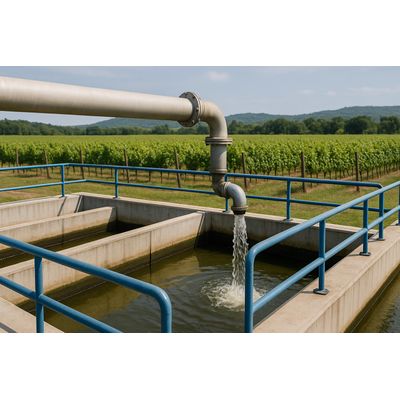
Recovering Nutrients From Wastewater
As sustainability goals tighten and water resources become more constrained, recovering nitrogen and phosphorus offers beverage and winery operators a practical path to reduce environmental impact while creating recoverable value.
Resource recovery as an asset for your beverage operation
Wineries and other beverage producers generate wastewater streams rich in organic matter and nutrients such as nitrogen and phosphorus. Traditionally, these nutrients have been removed to meet discharge regulations, with the resulting streams treated as a disposal challenge rather than a recoverable resource. Across the food and beverage industry, the mindset is shifting toward viewing wastewater as a source of value that can be recovered and reused.
This approach aligns with Fluence’s integrated water management philosophy, which brings together treatment, water reuse, and resource recovery into a single, efficient system. Beverage wastewater often presents challenges such as:
- High-strength wastewater with elevated biochemical oxygen demand from sugars and organics
- Fluctuating flows tied to production cycles
- Rich nutrient content including nitrogen and phosphorus
Nutrient Recovery
Advanced treatment technologies now enable simultaneous nutrient removal and recovery. Biological nutrient removal systems, membrane bioreactors (MBR), and anaerobic digestion can be combined to stabilize wastewater, reduce nitrogen and phosphorus loading, and generate usable by-products. In practice, this can translate to generating biogas for energy, reclaiming treated water for reuse, or capturing nutrient-rich streams for agricultural use.
The broader beverage industry is increasingly pursuing water reuse and nutrient recovery. Fluence’s work with Monster Energy demonstrates how advanced membrane and reverse osmosis systems can optimize water use across operations, reflecting the same principle of optimizing water use throughout the facility. The trend is extending downstream, where wastewater treatment becomes a source of recovery and reuse rather than mere discharge.
Supporting Circular Water Strategies
As sustainability goals become more ambitious and water resources more constrained, recovering nitrogen and phosphorus offers a practical step for beverage producers. It reduces environmental impact, supports regulatory compliance, and enables more circular operations by treating nutrients as a recoverable resource that can improve overall efficiency and align with future industrial water management.
One example of a nutrient recovery approach is Fluence’s PHOS-PURE technology. PHOS-PURE is a struvite recovery process that enables removal and recovery of phosphorus and nitrogen from nutrient-rich wastewaters such as digestates, centrates, and filtrates. The system promotes reduced nutrient loading at existing facilities while recovering phosphorus and nitrogen for reuse as slow-release fertilizer. Wastewater enters a reaction stage where magnesium, ammonium, and phosphate combine to form struvite crystals, which are then separated and recovered to support nutrient reuse within a more circular wastewater strategy.
If your beverage operation is exploring nutrient recovery, water reuse, or sustainable wastewater management strategies, Fluence can help design a tailored solution to meet operational and compliance goals.
Original: https://www.fluencecorp.com/nutrient-recovery-from-wastewater/