
Reducing Leakage in Jakarta - Case Study
In 2005 it could be said that Jakarta, the capital city of Indonesia, was losing nearly 50% of its produced water from leakage in the network. Jakarta is a sprawling city of around 12 million residents (at that time), and towards the end of the 1990s the management of the network had been privatized into two separate concessions. This paper is based on the section managed by the Palyja, a Suez Group company.
The network extends for over 3.000km and consists of mainly non-metallic piping in sizes 25mm through 1200mm units pressure at most 15 meters.
At the end of many zones the pressure can typically be at zero for most of the day, as in many cities, the traffic appears to be permanently grid-locked. Systems range from newly built to old and abandoned. NRW is typically 75% (real).
As always, a key element of permanent leakage control is not just to reduce the leakage but to enable a low leakage level to be maintained. The approach developed for Jakarta proved to be highly successful in finding leaks, however it quickly became apparent that as soon as a leak had been located and repaired, then another broke somewhere else!
The benefits of lowering pressure have been exploited all over the world, although typically these applications have been with pressures that were higher. Less well appreciated is the positive impact that controlling pressure has on leakage rates with low pressures as was the case with Jakarta.
High leakage creates high flow which in turn increases head loss and reduces pressure. When the leaks are repaired, the converse becomes true, and the resultant higher pressures cause an increase in loss through small leaks, but also an increase in new leaks. It became very clear then that the solution to the problem of recurring leakage in Jakarta was pressure control. However, it was not clear if a pressure control system would work with pressures as low as 10 meters.
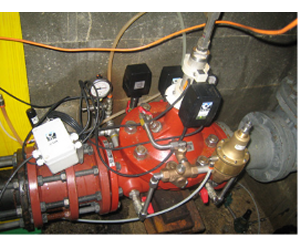
A trial was undertaken in a pilot area of around 20 square kilometers where a high quality Cla-Val valves were installed with very positive results. Not only could the valves maintain a constant downstream pressure, it allowed even further reduction of leakage.
Over 500 90 series control valves were installed, with many having a time or flow based controller, and to this day continue to deliver fault-free performance. This proves that selection of high quality and well engineered products justifies the often initial higher capital costs.
The battle to stay on top of leakage continues in Jakarta, but it can be very safe to say that that use of Cla-Val automatic control valves contributed in no small way to the success enjoyed so far!