

- Home
- Companies
- Guangzhou Shincci Energy Equipment Co., ...
- Articles
- Sludge drying and disposal ways
Sludge drying and disposal ways
With the rapid growth of urbanization in my country in recent years, a large number of centralized sewage treatment plants have been added and expanded, and the output of sludge has increased rapidly. It is estimated that the annual output of dewatered sludge will reach 30 million tons. Whether from the perspective of pathogens or heavy metals, the traditional treatment methods of direct landfill, reclamation and fertilization of concentrated and dewatered sludge are no longer suitable for the current higher and higher requirements for environmental protection. Handling and disposal have become the most urgent problems to be solved at present.
The current advanced sludge disposal methods include drying, solidification, composting, carbonization, and incineration. Composting is not effective in reducing weight, and is affected by different factors such as site, weather, transportation, and market, and has certain limitations. Curing is more often used as a temporary or alternative disposal method due to the disposal of the final product. Incineration is the most thorough sludge treatment method, but there are also many controversies, especially in terms of carbon emissions, and at the same time, the sludge has not been completely recycled. Drying is a radically reduced treatment that facilitates transport and storage while completely killing pathogens, and the final product can be used as fertilizer, feedstock and alternative fuel. Drying can not only exist as an independent treatment process, but also can be integrated into a complete sewage and sludge treatment system.
It is a good solution for the optimization, stabilization and resource utilization.
The sludge drying system mainly has the following characteristics:
(1) The sludge is hygienic and safe during the treatment process. In a sludge dryer, the sludge is kept at a constant temperature in inert superheated water
level for reliable sanitation.
(2) Automatic granulation during sludge treatment. The back-mixed dry sludge acts as the inner core of the granules, which automatically forms a granular state during the sludge drying process.
(3) The released gas is safe. Best-in-class hot gas deodorization systems have been used in hundreds of applications to remove mercaptans and gases and their pungent components.
Proven in engineering cases to ensure that gases released into the atmosphere are effectively purified.
(4) The amount of gas required for gas cleaning in thermal deodorization systems is relatively small.
(5) Minimal risk. The superheated steam in the dryer fully complies with the requirements of the ATEX directive, making the
Minimal risk.
(6) The heat recovery potential of the drying process is extremely high in the high temperature range, which can be used for digester heating and other heating purposes.
The dehydrated sludge is sent out from the screw conveyor, and then enters the dryer after back-mixing with the dry sludge, and the heat medium at the same time.
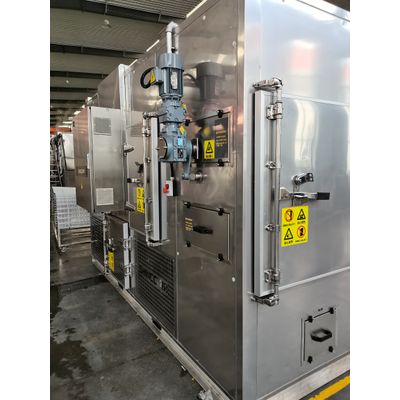
(Steam, heat transfer oil, flue gas, etc.) are passed into the stainless steel tube bundle inside the dryer, and the drum rotates slowly to make the sludge fully contact with the heated tube wall, heat exchange is carried out, and the water is evaporated. At the same time, a small amount of circulating air is introduced to take away the water vapor evaporated from the sludge. The slightly inclined angle of the drum and the circulating air in the dryer make the sludge move and transport in the machine.
Finally, it is sent to the burner for deodorization treatment and then recycled.
At present, the most common sludge drying,
The incineration process refers to drying the dewatered sludge with a water content of about 80% to about 45%-55% water content by a dryer, and then sending this part of the sludge into an incinerator (usually bubbling fluidized bed or circulating fluidized bed). At the temperature of about 850 to 950 degrees, the harmful substances in the sludge are completely decomposed, and at the same time, the production of harmful gases such as NOx and dioxins during the incineration process is also excellently controlled. Considering that the calorific value contained in the sludge is too low to achieve a complete energy balance, coal or fuel oil is usually added as a supplementary fuel. The sludge is used as fuel for the incinerator, forming an integrated system.
The sludge digestion tank and the sludge drying system can be integrated into a complete system. First, the concentrated sludge is sent to the digestion tank for digestion to generate biogas, and the biogas is sent to the gas generator of the dryer behind to burn to generate about 400 degrees Celsius. At the same time, the heat energy recovered in the drying process can supply heat for the sludge digester, and the whole system achieves energy balance and is self-sufficient. However, considering the factors such as low organic matter content and low calorific value in domestic sludge, additional energy is needed when necessary, but overall a lot of energy is saved.
At present, there are dozens of sludge drying processes, and how to choose a suitable process is what users are concerned about. the author on this
Give some opinions of yourself: In addition to the cost of the equipment itself, the operating cost is also a point that must be considered. Its determinants are nothing more than energy consumption, depreciation maintenance, labor, etc. Among them, energy consumption is the most important, so how to choose The most efficient energy and full utilization is the focus of sludge drying. Therefore, the author suggests that the waste heat from surrounding thermal power plants should be used as much as possible, including low-quality steam and flue gas. Secondly, in some large and medium-sized sewage and sludge treatment plants, the biogas generated by the digestion of sludge is used to make drying and digestion into a complete system. Thermal energy provides heat for sludge digesters or for buildings in sewage treatment plants. Final dry sludge, except
It can be used as a solid bio-fertilizer, as an alternative fuel or as a raw material for building materials. In a word, sludge drying is one of the most effective methods to achieve harmlessness, reduction, stabilization and resource utilization of sludge. Although it is a lot of money in terms of construction cost and investment, sludge drying is not just an independent treatment process, but can be integrated with the front and rear processes, and even the entire sewage treatment plant, so as to Maximize the use of resources, fully save energy, and ultimately achieve the purpose of energy conservation and emission reduction.