
solid-organic-waste Downloads
30 downloads found
Premium
Household waste generated from toilet waste, kitchen waste, and laundry and bathwater, flow from the household drains into your septic tank. Some of the old solid organic material flows to the top of the tank (the "scum layer."). Inorganic material along with some organic material and byproducts of the bacteria digestion settle to the bottom of the tank (the “sludge layer.”) For a ...
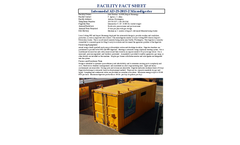
The HORSE, 25 Series Bioenergy System (aka H-O-R-S-E) is designed to scale down the size and cost of anaerobic digestion (AD). This system provides on-site generation of energy from food waste and similar organic materials. This can reduce the environmental footprint of even a single cafeteria or restaurant by offsetting trucking offsite to distant facilities, while also offsetting less ...
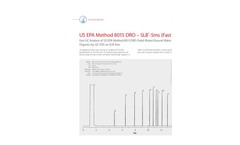
This carbon range represents the elution range of what is often termed as "diesel range organics" or US EPA Method 8015 DRO – SLB®-5ms (Fast Analysis)Fast GC Analysis of US EPA Method 8015 DRO (Solid Waste/Ground Water Diesel Range Organics by GC-FID) on SLB-5ms1. ...
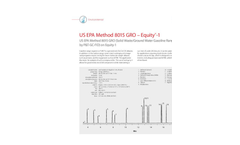
EnvironmentalGasoline range organics or “GRO” is a general term for C6-C10 alkanes. In addition to this carbon range, some states’ underground storage tank programs require testing for lower molecular weight alkanes such as pentane, and for oxygenates such as MTBE. ...
EnvironmentalGasoline range organics or “GRO” is a general term for C6-C10 alkanes. In addition to this carbon range, some states’ underground storage tank programs require testing for lower molecular weight alkanes such as pentane, and for oxygenates such as MTBE. ...
Our Waste2Energy™ anaerobic digestion is a natural process where microorganisms break down organic material in the absence of oxygen. At an anaerobic digestion facility, this process occurs in airtight tanks. Solid and liquid organic waste material is macerated and blended into a homogenous slurry and dosed into the system. Anaerobic bacteria break down organic waste by feeding on the fats, ...
Zero Waste Energy offers a high-solids, batch processing anaerobic digestion design for facilities starting as low as 5,000 TPY and up to 90,000 TPY of almost any organic material utilizing SMARTFERM proprietary technology. The batch processing is well suited for the production of biogas from stacked solid organic waste in a non-continuous process. Unlike other dry fermentation technologies, ...
These enzymes ‘digest’ the stain and odorcausing organic material, eliminating the stain and the odor at thesame time. Use on all types of surfaces, including carpet, furniture,bedding, pet cages & litters, bird and animal roosts, and more.Check surfaces for color fastness in a small hidden area beforewidespread application.For newly soiled areas, dispose of any ...
Anaerobic digester for biogas and electrical energy production from organic fraction of municipal solid waste (O.F.M.S.W.). The Wastepower plant is based on wet anaerobic digestion of input materials, where organic substances are degraded by microorganisms in the absence of oxygen (anaerobic condition) at a temperature of ...
Treatment of Hazardous and Non-Hazardous Aqueous Waste – Clean Harbors’ facilities are permitted to treat a wide variety of hazardous and non-hazardous wastewaters including: • RCRA hazardous waste • Listed hazardous waste • CERCLA hazardous waste • TSCA, RCRA/TSCA & non-TSCA PCB waste • Non-RCRA regulated ...
www.biogas-weser-ems.de www.biogas-weser-ems.de BWE Newsletter February 2015 AD plant in Coleshill (UK) in operation 4th BWE waste plant to start in the UK: The Coleshill Anaerobic Digestion Facility has been commissioned in January 2015 after ...
An array of processes is in place to support the three treatment technologies either by preparing the waste for treatment or by disposing of the treated residue.INCINERATION Organic wastes in solid, liquid or sludge form are destroyed in the incinerator at temperatures up to 1,300º Celsius. ...
www.bta-international.de Company Profile BTA International GmbH is the leading specialist for the wet mechanical pre-treatment of different kinds of waste and the subsequent anaerobic digestion of their organic fraction. The BTA® Process is a combination of the BTA Hydromechanical Pre-treatment with an anaerobic digestion step for the utilization of the ...
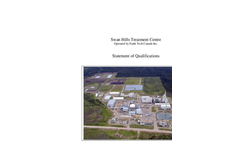
The facility comprises three treatment units: • High Temperature Incineration – for the destruction of organic wastes (liquids, sludges and solids). Examples include wastes contaminated with PCBs, PCPs, dioxins and furans, air and water reactive materials and odorous materials. • Physical/Chemical Treatment – for the treatment ...
Automatic flushing of the system dramatically reduces maintenance.The benefits of recirculating leachateThe reintroduction of moisture to the landfill cell mass dramatically speeds up decomposition of organic material and breaks down the leachate. Instead of preserving the organic solid waste in a traditional “dry tomb” ...
Biofuels We are capable of generating bio-based fuels from waste and waste water, such as, hydrogen, pyrolysis oil and dried, pelletized organic compounds. ...
Heralt Schöne, Hochschule Neubrandenburg, GermanyLiquid feeding in biogas plants, Peter Nemeth, Pumpenfabrik Wangen GmbH, GermanyIntelligent thermal energy management using a novel multi-chamber biogas reactor – a prototype, Michael Müller, Prüf- und Forschungsinstitut, GermanyMonitoring of gas parameters to control feeding cycles, Manuela Charatjan, Binder GmbH, GermanyAnaerobic Digestion of ...
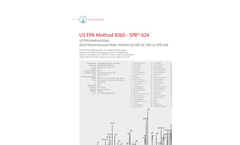
EnvironmentalUS EPA Method 8260 describes the analysis of volatile organic compounds in solid wastes and ground waters. This application illustrates the analysis on the SPB-624 of many compounds commonly analyzed by this method using purge and trap coupled to GC-MS.US EPA Method 8260 - SPB®-624US EPA Method 8260 (Solid ...
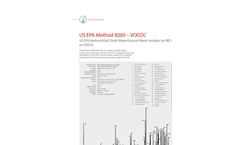
EnvironmentalUS EPA Method 8260 describes the analysis of volatile organic compounds in solid waste and ground water. This application illustrates the analysis on the VOCOL column of many compounds commonly analyzed by this method using purge and trap coupled to GC-MS.US EPA Method 8260 – VOCOL®US EPA Method 8260 (Solid ...
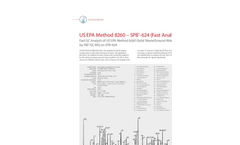
EnvironmentalUS EPA Method 8260 describes the analysis of volatile organic compounds in solid waste and ground water. This application illustrates the analysis of many compounds commonly analyzed by this method using purge and trap coupled to GC-MS. ...