
Refine by
Plume Modeling Articles & Analysis
16 news found

CERC recently contributed modelling expertise to a comprehensive Environment Agency (EA) report that reviewed methods for air quality monitoring and modelling, and their integration. The report examines both well-established techniques already employed by the EA, such as Gaussian plume dispersion for air quality modelling, and ...
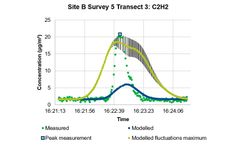
CERC have previously developed and implemented an inverse dispersion modelling approach for improving estimates of urban emissions. For this project we developed a new 'modified Bayesian' inverse modelling technique, due to the short timescale of the plume transect measurements. Measurements at 1 second intervals capture the instantaneous rather ...
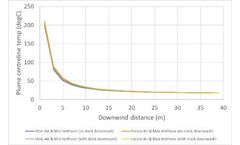
ADMS 5 includes a temperature and humidity output option. The plume temperature output from this model option was used to calculate the convective heat impact. The first figure shows plume centreline temperature with downwind distance. The similar temperature drop-offs with distance for all flare source scenarios highlighted that ...

CERC was commissioned to carry out a novel assessment of the impact of plumes of cold air from an array of Air Source heat Pumps (ASHPs) on the surrounding air temperature. In work commissioned by Sustainable Energy Ltd, the CERC consultancy team used ADMS 5 and the dense gas dispersion model GASTAR to carry out dispersion modelling of the ...

Scientists at NOC have used the state-of-the-art NEMO ocean circulation model, alongside a particle-tracking algorithm, to simulate the plume from a subsea oil blow-out. The results have been published in the journal Marine Pollution Bulletin and show that the distance an oil plume would reach depends on both its release depth, and the ...

WKC speakers will present papers on the latest capabilities of oil spill simulations, real time air dispersion modelling and it’s value for industrial cities, and terrestrial ecology conservation challenges. Th WKC team of speakers includes Dr Stephen Crute (ecology), Shaun Pearce(air quality) and Dr Graeme Hubbert (oil spill modelling and oceanography). In ...

Marine diesel contains sulphur compounds, which generate sulphur oxide (SOx) pollution and acid rain. Ships can use mitigating technologies to reduce their SOx emissions, but these can also have a negative environmental impact. The International Maritime Organization (IMO) introduced stringent legislation to control these, aspects of which are incorporated into EU policy. This study examined the ...
One plume and multiple soil areas on Camp Edwards await final cleanup decisions. ...
ProRAE Guardian is compatible with optional PlumeRAE plume modeling and HazRAE hazardous material decision-support software to increase public and emergency responder safety. ...
The System is also compatible with optional PlumeRAE plume modeling and HazRAE hazardous material decision-support software to increase public and emergency responder safety. ...
Monitoring and investigations have shown that groundwater contamination from the site is not currently threatening public or private drinking water supplies. However, without cleanup, plume modeling projected potential drinking water threats to residents between the northwest side of MMR and the Cape Cod Canal. ...

The team combined data from six NASA, European Space Agency and Canadian Space Agency satellites, field observations and a model of how air moves in the atmosphere to link Arctic sea ice changes to bromine explosions over the Beaufort Sea, extending to the Amundsen Gulf in the Canadian Arctic. ...
Monitoring and investigations have shown that currently, groundwater contamination from the site is not threatening public or private drinking water supplies. Plume modeling without cleanup, projected future potential threats to residents between the northwest side of MMR and the Cape Cod Canal. ...
In response to a request by the World Meteorological Organization (WMO) to support IAEA, the Central Institute for Meteorology and Geodynamics in Austria (ZAMG) has developed plume calculation models. The European Nuclear Safety Regulators Group (ENSREG) provides further information on nuclear safety and emergency arrangements at different levels of governance. ...

RMA’s services include contingency and regulatory plans; safety, security and response training; drills and exercises; crisis, disaster and incident management; Qualified Individual (QI) services; environmental permitting and compliance; federal grant administration; high-resolution graphics; geographic information systems (GIS) and mapping; customized compliance software development; and oil ...
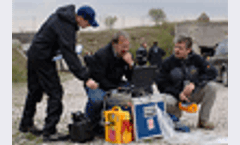
The preliminary capability registrations made to RANET include: Use of a radiation biodosimetry laboratory from Finland, technology used to calculate radiation doses to potential accident victims; Capabilities in radiation monitoring, environmental measurement, source, search and recovery, and internal dose assessment by Mexico; Measurement capabilities and a source search and recovery team ...