
Refine by
Viscosity Testing Articles & Analysis
44 news found

Key features: Cell recognition accuracy>90% World first “microscopy + dry chemistry” integrated chip Patented algorithm for tracking and recognizing trichomonas morphology Cartridge clip, continuous loading 60 cards Auto testing of sample turbidity, auto dilution of high concentration sample Testing speed: 40T/H ...

Earlier this month, Alfa Chemistry Testing Lab, an independent third-party testing laboratory, announced its decision to launch a full range of coating and paint testing services for varieties of components and materials. ...
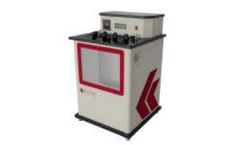
(USA) is pleased to announce our new K23900 Kinematic Viscosity Bath. The Koehler Kinematic Viscosity Bath is designed to conduct tests to determine the viscosity of liquid petroleum products, both transparent and opaque, by measuring the volume of liquid to flow under gravity through a calibrated glass capillary viscometer. ...

Poster #103 (3:55 PM): ILSAC GF-6: A New Level of Performance for Engine Oils to Meet Changing Fuel Economy and Emission Standards Poster #104 (10:30 AM): How Oil Companies can use EDXRF Technology to comply with the EPA Tier 3 Standard Requirement of Low Sulfur Fuel and other Key Applications Poster #105 (11:10 AM): Recent Improvements for ASTM D86 Distillation Testing ...

The MicroLab automated analyzer series provides complete oil analysis testing including chemistry, kinematic viscosity and concentration of up to 20 wear, additive and contamination elements, in addition to an optional particle counter. ...
The new MiniLab EL Series from Spectro Scientific is a fast, convenient oil analysis tool for non-destructive testing of high performance engines in aircraft, racing cars, and railway environments. Oil analysis is a reliable and mature non-destructive testing technique that is widely used in engine design and development, production quality assurance, and in ...

The requirements specified for diesel fuel oils shall be determined in accordance with the following test methods: flash point; cloud point; water and sediment; carbon residue; ash; distillation; viscosity; sulfur; copper corrosion; cetane number; cetane index; aromaticity; lubricity; and conductivity. ...
This test is primarily used for field production control of Asphalt-Rubber (A-R) and other high viscosity binders; however the test can also be used in a laboratory setting. ...
These test methods cover the physical testing of joint treatment materials such as joint compound, paper joint tape, glass-mesh joint tape, and an assembly of joint compound and paper joint tape. These materials are used in gypsum board construction. The test methods are detailed for the following: joint compound ...
This test method covers the procedures for determining the viscosity of transparent liquids by bubble time method. The transparent liquids should be free from crystalline or gel particles. Test apparatus include a constant-temperature bath, standard viscosity tubes, a series of standard viscosity tubes ...
This standard describes an apparatus that provides the versatility required to conduct oxidation or thermal stability tests on liquids using a wide variety of test conditions. It is sufficiently flexible so that new test conditions can be chosen in response to the changing demands of the marketplace. Procedures using ...
These test methods are intended mainly for referee purposes but may be used for quality control of masterbatch production. ...
These test methods are intended mainly for referee purposes but may be used for quality control of rubber production. ...
Different processes and different processing equipment often require rubber of the same composition at different raw Mooney viscosity levels. The use of this practice enables producers of SBR to offer each rubber with a number of standard target Mooney viscosity values and informs users which Mooney viscosity rubbers are ...
These tests are used as a means of classifying, evaluating, and controlling cement compositions. ...
Materials are classified into grades according to retained dirt content, ash content, volatile matter content, nitrogen content, initial plasticity, plasticity retention index, color index, and Mooney viscosity. Skim rubber is not permitted in any grade. This abstract is a brief summary of the referenced standard. ...
These test methods are intended mainly for referee purposes but may be used for quality control of rubber production. ...
As it pertains to the API SL engine oil category, it is based on engine test results that generally have been correlated with results obtained on reference oils run in gasoline engine Sequence Tests that defined engine oil categories prior to 2000. It should be recognized that not all aspects of engine oil performance are evaluated by the engine ...
This test is primarily used for field production control of Asphalt-Rubber (A-R) and other high viscosity binders; however the test can also be used in a laboratory setting. ...
Viscosity has significance in the use of emulsified asphalt because it is a property which affects their utility. ...