


Ecoslops Technology
Ecoslops has an innovative technology, enabling the processing of oil residues into valuable new products (new fuels and light bitumen). Ecoslops is the cleantech that brings oil into circular economy. Its first industrial-scale processing unit has been operational since June 2015 in the port of Sinès, Portugal.
Ecoslops technology is based on:
- perfect control of the collection, processing and refining processes of slops and sludges from maritime transport
- a major innovation that combines treatment of oil residues and refining techniques applied to marine litter
With its integrated and innovative approach, Ecoslops offers port infrastructure, waste collectors - maritime and terrestrial- and ship-owners a cost-effective, environmentally friendly solution that complies with international and European regulations regarding the collection and processing of slops. In this respect, Ecoslops has concluded several commercial agreements, notably with European shipowners and collectors.
The hydrocarbon residue reprocessing unit is the heart of the Ecoslops technology. It is a major innovation in the sector. Thanks to its refining process, Ecoslops transforms collected slops into a perfectly usable fuel (Naphta - Diesel Oil - Fuel Oil). The Ecoslops industrial site is the first in the world to produce new fuels that comply with international standards. Ecoslops technology is also compliant with international standards for gaseous emissions and liquid and solid emissions.
Ecoslops technology is based on several steps fully integrated:
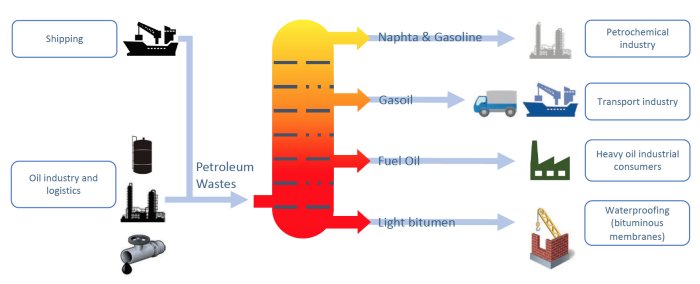
Processing maritime oil residues with Ecoslops technology offers a new and attractive alternative to the major groups concerned by the environmental and economic impact of maritime oil waste.
Port strategy integrated solution
Each step in the process is both easily traceable and transparent ; from collecting to using via processing. Compliance with international rules (MARPOL, etc.) applies to every single business in this sector of activity.
Sustainable and economicalThe P2R unit recycles 98% of oil waste. This is a circular economy solution which allows to protect fossil energy sources and improves this sector of activity`s material balance. Oil residues upgrading also allows to decrease illegal oil spillage - be it sea or ground. Eventually, greenhouse gases emissions are three times less important than the conventional oil production cycle (cf Carbone 4 survey here).