


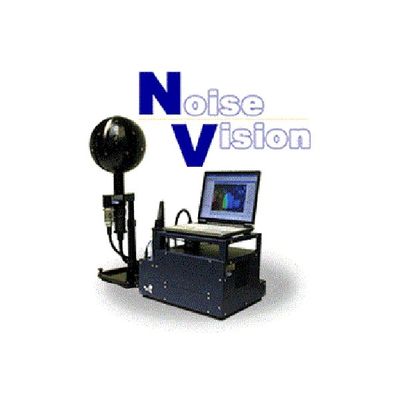
Noise Vision - Omnidirectional Sound Source Identification System
he Noise Vision omnidirectional sound source identification system is designed as a sound source identification and visualization system that does not assume where the noise is coming from. It has been well received by a wide range of customers, leading to its wide use in various fields.
The application of this product is versatile, including identification of interior noise sources in automobiles, factory noise source identification, and room acoustics visualization and so on. The system is designed for easy and quick setup, with preparation taking less than 10 minutes. Analysis is also fast, and sound source can be visualized on the pictures within minutes. This efficient system can be utilized in product development. (Patented internationally)
Omnidirectional sound source identification system
Prior to the Noise Vision, the noise source location had to be supposed due to the technical limitation of the system. This system arose from the need for the ability to identify the noise source without knowledge where the noise is radiated or leaked from. As such, Noise Vision incorporates a spherical microphone array (Sphere-Baffled Microphone array, SBM), an omnidirectional sound source identification system.
Omnidirectional visualization
Noise Vision is designed with twelve on-board cameras arranged on the surface of the spherical sensor. The sound source information is displayed on the pictures taken by the on-board cameras, ensuring that all around area is covered and allowing anyone to clearly recognize the root cause of the noise.
Noise measurement and "speed"
Although the Noise Vision system is a complex system that uses multiple microphones and cameras, the setup speed is particularly noteworthy. The system can be installed with data acquisition possible in just 10 minutes. In addition, optimization of the software, which features an excellent user interface, and of the analysis algorithms means users are able to obtain a visualization of a sound source just minutes after measurement, followed by automatic report creation.
"Reliability" and many achievements
Nihon Onkyo Engineering has worked with variety of customers to provide acoustic measurement and simulation systems. Moreover, the acoustic consulting services are provided in more than several hundred projects a year. With abundant maintenance experience for the systems constantly in operation, we promise reliable support long after delivery and commissioning.
Optimized spherical beamforming algorithm for mid to high frequency
This algorithm has been developed to visualize sound sources located everywhere around the spherical sensor using on the pictures taken by the onboard cameras. Nihon Onkyo Engineering`s original optimization algorithm both improves resolution at low frequencies and reduces the ghosts at high frequencies. In automotive applications, this algorithm is ideal for use with mid to high-frequency phenomena such as wind noise and BSR (buzz, squeak and rattle).
Spherical nearfield acoustic holography algorithm for low-frequency
The Spherical Nearfield Acoustic Holography (SpNAH) algorithm uses the microphones mounted on the sphere to calculate and visualize the sound pressure, particle velocity as well as sound intensity around the sphere. Whereas the spherical beamforming has difficulty working with wave-specific phenomenon (such as standing waves) in a confined space especially at low frequencies, SpNAH is specifically designed for low-frequency. Moreover, SpNAH is also an excellent method for rapid measurement of sound pressure distribution in a confined space.
Powerful technique — Virtual reference analysis
The virtual reference analysis function can be used in a variety of possibilities, from discovering hidden noise sources by excluding the effect of the noise coming from the specific location, or to improve resolution by emphasizing the source location only. In addition, the position can be set freely during analysis because there is no need to install a reference sensor during experimentation.
Specialized software for sound source identification
Efficiently designed software allows users to perform advanced analysis as desired, from data acquisition to analysis and reporting. Results can also be utilized quickly through the user interface capable of intuitive handling of complex processes such as time domain analysis and virtual reference functions. In addition, real-time processing functions are available for visualizing sound sources in real time.