


- Home
- Companies
- Sterlitech Corporation
- Products
- Sterlitech - SEPA Cell
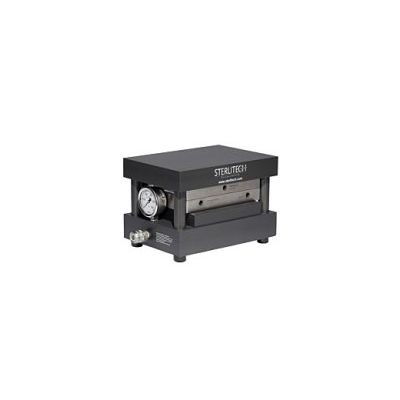
Sterlitech - SEPA Cell
The SEPA Cell is a bench-scale cross/tangential flow cell that provides fast and accurate performance data with minimal amounts of membrane, product, expense or time.
Sepa Cell Features and Benefits:
- Accepts polymeric flat sheet membrane coupons
- Mimics both laminar or turbulent flow conditions
- Provides fast and accurate performance data
- Offers judicious membrane use with small membrane active area
Sepa Cell has a membrane active area of 140 cm2 (24 in2).
Sepa Cell is available in Stainless Steel with a maximum operating pressure of 1000 psi (69 bar), which allows operators to conduct high pressure testings.
Sepa Cell is also available in Acrylic with a maximum operating pressure of 100 psi (7 bar). Acrylic Sepa Cell provides a great opportunity to visually investigate the hydrodynamic conditions in the cell or the local fouling intensity.
In order to operate the SEPA Cell additional parts and equipment are required, which include:
- Sepa Cell body holder
- A hydraulic hand pump to pressurize the Sepa Cell holder
- Feed flow pump designed for high pressure, lower flow applications
- Feed spacers or permeate carriers which mimic hydrodynamic conditions of large scale membrane modules
- Feed and permeate tanks which connect to the cell
- Concentrate control valve to pressurize the cell
Please visit cross flow cell system component page for the list of all the parts and equipments required to build a complete filtration system configured with Sepa Cell and other cross/tangential flow cells Sterlitech offers.
Please note: In order to operate the SEPA Cell, a feed flow pump is also required. We recommend the Hydracell pump by Wanner Engineering, which is a positive displacement, diaphragm pump designed for high pressure, lower flow applications. When ordering, you will need to specify the power requirements for the motor. The minimum power available is 110V, 60 Hz. 220 V and 50 Hz motors are also available. There may be an additional cost if a variable speed drive is required. The SEPA Cell hand pump is required in order to pressurize the cell holder but is not used for liquid flow.
Cross/tangential flow test cells are typically used in membrane applications such as :
- Biological or biopharmaceutical processing
- Concentration of fruit juices and extracts
- Food and beverage processing
- Desalination of brackish water or seawater
- Purification of rinse water in electroplating tanks
- Municipal or industrial water and wastewater purification