


- Home
- Companies
- Del Mar Oceanographic LLC
- Products
- DMO - Model Wirewalker - Vertically ...
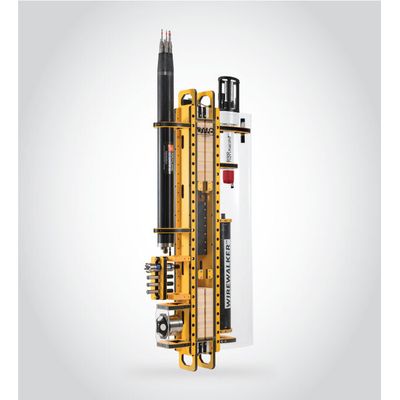
DMO - Model Wirewalker -Vertically Profiling Instrumentation-Platform
The Wirewalker is a vertically profiling instrumentation-platform, powered by ocean waves. Through the Wirewalker’s rapid profiling and ability to integrate a wide variety of sensor payloads, it brings new life to typical one-dimensional sensor time-series as a 2-D depth-time image where an enormous increase in information and intuition is achieved.
Ø BATTERIES REQUIRED
The Wirewalker is a robust mechanical system, requiring no electronics or battery power for propulsion. Any on-board power is exclusively used to extend the duration of the integrated sensing payload.
10 METERS PER MINUTE
Deployments range from open-ocean free-drifting stations to inner-shelf moorings. With a target buoyant ascent rate of about 0.5 m/s, typical round trip profiling rates average about 10 m/min; that’s more than 100,000 m profiled per week!
500+ METERS DEPTH RANGE
The Wirewalker excels at capturing an accurate view of the upper ocean. Profiling ranges up to 500m deep are commonplace; however, 1000m deep profiles are possible with the right instrumentation and high density buoyancy.
>25k KILOMETERS PROFILED
Over the past decade on deployments around the globe, Wirewalkers have made hundreds of thousands of profiles, spanning tens of thousands of kilometers in vertical distance; all powered by surface waves!
A length of wire is suspended from a small surface float. At the deep end of the wire a weight encourages the entire length of wire to move vertically, following the oscillatory motion of the surface float. The Wirewalker profiler rides along the wire, with an internal cam grabbing the wire when it descends and releasing when the wire ascends. At the bottom of the desired profiling range, the profiler collides with a mechanical turnaround bumper which releases the cam, enabling the Wirewalker to free-ascend to the top of the wire under its own buoyancy. As demonstrated in the video, the cam is reset and the cycle repeats.
Typical profiling speeds are on the order of 10 m/minute, round-trip, through a wide range of sea states.
The Wirewalker stop-motion animation (courtesy of long-time Wirewalker user Melissa Omand (URI) and Colleen Durkin) is a fantastic visualization of how the Wirewalker works. It also highlights the Wirewalker’s modular design and ability to accept a large custom payload.
The surface buoy’s primary function is to harvest the energy from the surface wave field. The surface buoy also acts as a platform for real-time satellite GPS tracking of the Wirewalker’s position and can be equipped with a real-time telemetry system via Iridium or GSM. The surface buoy has been designed for optimal handling and efficient operation in a wide range of wave conditions. It comes equipped with a flasher (aka strobe) for deployment and recovery operations. The use of a positioning beacon is strongly recommended.
PROFILING WIREThe Wirewalker profiler travels along a jacketed profiling wire that links the surface buoy above, to the downweight below. This wire transmits surface wave energy deep into the sea through its mechanical motion. The length of the wire, along with turnaround bumpers attached near each end, define the upper and lower limits of the profiling range. In addition to providing motive power, the jacketed profiling wire also enables use of an inductive communications link between the moving profiler and the surface float.
WIREWALKER PROFILERThe profiling vehicle (the “Wirewalker”) consists of the instrument platform itself, including the cam mechanism that selectively engages the profiling wire when descending. The cam mechanism drives the profiler downward, using wave action, to the end of the profiling wire, at which point the cam releases, allowing the profiler to float freely up to the surface. The profiler houses a configurable set of oceanographic sensors as well as a configurable set of depth rated foam to set the positive buoyancy. Various foam densities are available and define the depth rating of the profiler (300m-1000m). The profiler is outfitted with asymmetric cowlings that give it a leading and trailing edge as they align the profiler body into the current.
DOWNWEIGHTThe downweight is suspended at the bottom of the jacketed profiling wire, just below the profiler’s lower turnaround point. Typically, two steel downweight plates totalling 40 kg (90 lbs), is sufficient to ensure that the profiling wire maintains the tautness needed for proper profiling of the water column. There are four mounting holes in the plates; these allow the plates to be linked in series or the holes can be staggered and the plates bolted together. In areas of high shear and/or currents, additional weight may be added.
The Wirewalker differs from most buoyancy or motor-driven profilers in that it can either be moored to the sea-floor or allowed to drift free with the currents (Lagrangian).
It can profile to within a meter of the sea surface in “undisturbed” water. Internally-recording, self-powered instruments are “interfaced” simply by bolting them to the Wirewalker and adjusting the floatation. Ballasting need not be as precise as with buoyancy-driven profilers. Just add pre-cut blocks of foam until the Wirewalker floats upward at about 0.5 m/s and you’re good to go.
Free-Drifting Example.
Moored Example.
Deepwater Mooring Example.