


Water FLUTe
A Trusted Technology for High Quality Multilevel Groundwater Monitoring Since 1996. The Water FLUTe is a depth-discrete multilevel groundwater monitoring and head measurement system for use in overburden and bedrock groundwater assessments.
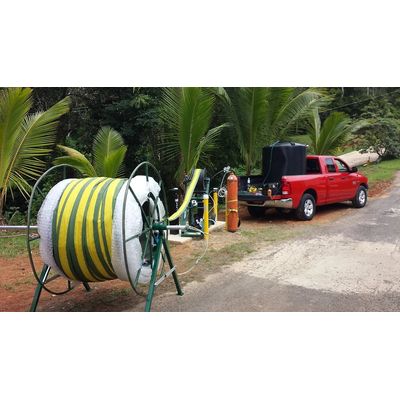
Installation: The Water FLUTe multilevel groundwater system is installed in open bedrock wells via eversion, in a similar process as a blank liner installation (Click Here for a basic installation overview or for a detailed installation PDF, Click Here). The Water FLUTe can also be installed in the overburden or unstable bedrock via sonic drilling.
The installation of a Water FLUTe is affected by the depth and diameter of the hole, the relative transmissivity of the hole, the depth to the water table, and the rate at which water can be supplied to fill the liner.
The system can be used for artesian situations with a heavy mud fill.
If the hole is too tight to allow the liner to push the water into the formation, the water can be pumped from beneath the liner using a pump tube emplaced in the hole before the liner installation.
Water FLUTe systems are usually installed in uncased boreholes. Installations into multi-screened cased holes are also common. Varying borehole diameters are accommodated from 3-30 inches. The Water FLUTe can be installed through smaller casing into larger open holes below the casing, or into "telescoped" casing. The liner is completely heat welded without the use of any glues.
Once the liner is fully extended in the hole, the geometry looks like that in Figure 1.
Note, that due to the size of the large tubing and pumping hardware components of the system, the pump system is not everted into the borehole, but simply lowered as a tubing bundle following the liner to the bottom.
Sample Intervals: All samples collected from the Water FLUTe are drawn directly from the formation, without the potential for cross contamination or leakage as possible with packer based multi-level systems. The Water FLUTe is capable of up to 15 ports per borehole depending on the hole diameter from 4 inches to greater and all intervals can be sampled and purged simultaneously.
After the Water FLUTe is installed, the formation water will flow from the formation into the screen, sample port, and up the tubing on the inside of the liner. The water then flows up through the first check valve and up both legs of the "U" shaped tubing (pump tube and sample tube) to a height equal to the head of the formation. The water level can then be measured in the pump tube from the surface prior to sampling with a water level meter.
To purge and sample the Water FLUTe, a gas pressure is applied to the pump tube at a pressure greater than the head of the formation. Once the pressure is applied, the first check valve closes, and the pressure forces the water to flow through the second check valve and to the surface through the sample tube. This process is repeated multiple times to both
purge the system and collect samples.
Click Here for a detailed sampling procedure PDF file.
Head Measurements: The water table depth at each port can be measured with a water level meter in the pump tube or, for continuous head measurements at each port, an air couple transducer (ACT) system or downhole pressure transducers can be used. Click here for more information on the ACT system.
Well Completion: There is no need for an exterior seal with grout, sand or bentonite. The liner seals the entire hole and the water is drawn directly from the formation. As such, there is no concern about the seal of granular materials in a slender annulus.
Warranty and Removability: The Water FLUTe system is fully warrantied and removable for other use of the borehole or easy abandonment by grouting the borehole.
Our experience with Water FLUTe multilevel groundwater monitoring system now spans 21 years. Water FLUTe systems have been installed in 48 states in the U.S., and many foreign countries. More detailed descriptions and publications are available on our publications page.