


- Home
- Companies
- LG Sonic B.V.
- Articles
- Ultrasonic Sedimentation Basin Algae ...
Ultrasonic Sedimentation Basin Algae Control: AWWA Opflow Study Documents Chemical-Free Results
In June 2026 a peer-reviewed article in AWWA Opflow documents sedimentation-basin algae control using an LG Sonic ultrasonic system at Central Alabama Water's Shades Mountain Filter Plant in Birmingham, Alabama. The system was installed in April 2024. After roughly one year, the seasonal filamentous algae along the basin perimeter largely disappeared. The authors characterize the technology as chemical-free, low-maintenance for localized basin algae control, and emphasize its role as a complement to existing treatment rather than a replacement. The study provides utilities with an independent, operations-focused reference for evaluating ultrasonic algae control.
Study scope and independence
- The article presents a full-cycle field evaluation conducted by Central Alabama Water with an academic partner from the University of Alabama.
- It reports practical findings from an installed system in an active drinking-water basin, not vendor claims.
Plant context and the operational problem
Shades Mountain Filter Plant uses conventional treatment: coagulation with ferric sulfate, flocculation, sedimentation in an earthen-bottom basin of just over four acres, followed by sand and anthracite filtration, disinfection with sodium hypochlorite, and pH/alkalinity adjustment with lime. The sedimentation step handles up to 80 million gallons per day (MGD).
For years, a perimeter mat of seasonal filamentous algae formed along the basin and around the filter intakes. While growth was persistent rather than explosive, it created downstream challenges, including algae carryover into filters, higher head loss, shortened filter runs, and increased chlorine demand, complicating maintenance of a post-filtration free-chlorine residual of 0.5 mg/L. Contributing factors include basin geometry, variable source-water blending, and warm summer temperatures, conditions familiar to surface-water plants.
Rationale for a chemical-free approach
Conventional practice uses upstream oxidants to suppress basin algae, which can elevate disinfection-byproduct formation and, depending on species and die-off, lead to taste-and-odor issues. The utility’s Research and Innovation Department sought a method to control algae without introducing chemicals that would raise DBP formation, leading to ultrasonic treatment as a complementary option.
Deployment and monitoring details
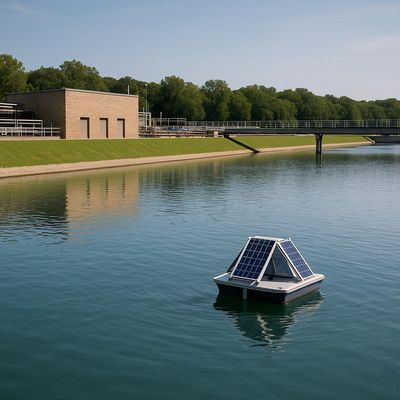
The MPC-Buoy ultrasonic system was installed near the filter intakes at the effluent end of the basin in April 2024. The solar-powered unit is designed for water bodies up to 500 meters in diameter. It emits low-energy ultrasonic waves at variable frequencies just below the surface to disrupt the vertical movement some algae depend on, limiting access to light and nutrients without chemical dosing. The system includes in-situ probes that log pH, temperature, turbidity, dissolved oxygen, chlorophyll-a, and phycocyanin at 15-minute intervals and feed a real-time dashboard. The utility also monitored dissolved organic carbon and UV254, and fluorescence spectroscopy at the University of Alabama characterized organic matter.
Key findings
The clearest result was visual: the perimeter algae mat appeared essentially absent after about a year of operation. Monitoring will continue as part of the utility’s evidence-based program. The study was careful not to overstate outcomes: there was no measurable reduction in chlorophyll-a or phycocyanin in the flowing source water, attributed to limited contact time in a high-flow basin moving up to 80 MGD. DOC and UV254 showed no significant changes, and a direct comparison of filter run times was not possible because a new high-rate filter building came online during the evaluation. Fluorescence data aligned with expected treatment performance.
Ultrasonic treatment in the treatment train
The authors frame the ultrasonic system as a complementary operational tool that reduces reliance on chemical algae control within the basin, rather than replacing upstream strategies. Enhanced coagulation and powdered activated carbon remain relevant for upstream blooms and taste-and-odor events. For plants with chronic basin-attached algae, ultrasound offers a low-maintenance, chemical-free option that can improve operational stability and reduce downstream filter effects. Longer-term datasets will help refine deployment and integration.
Implications for utilities
Plant managers aim to prevent attached algae from entering filters and to maintain stable chlorine residuals while avoiding additional chemistry that could complicate DBP and taste-and-odor management. This study provides operator-focused evidence—named utility, academic partner, full monitoring cycle, and clearly stated limitations—presented in a respected industry journal, supporting the consideration of ultrasonic sedimentation-basin algae control as a field option.
System capabilities
- Up to 90% chlorophyll-a reduction
- 24/7 real-time monitoring
- 10K+ deployments worldwide
Read the study and next steps
The article is titled Ultrasonic Treatment Reduces Sedimentation Basin Algae Growth by Vines, Cochran, and Terry, published in AWWA Opflow in June 2026. For utilities evaluating ultrasonic control, the MPC-Buoy provides integrated treatment and monitoring to support basin management decisions.
Facing chronic algae in your sedimentation basin? Attached algae can shorten filter runs, raise chlorine demand, and drive oxidant consumption. Ultrasonic treatment may be worth evaluating for your basin. The MPC-Buoy combines ultrasound with continuous water-quality monitoring for operational visibility and control.
Notes: This content reflects the study and product framing common to industry case evaluations and is intended for utility decision-makers. The final assessment should consider site-specific data, source water, basin configuration, and regulatory requirements.
Original: https://www.lgsonic.com/sedimentation-basin-algae-control-awwa-opflow/